

Written by Francois Hoogstrate
Last update: 22-08-2026
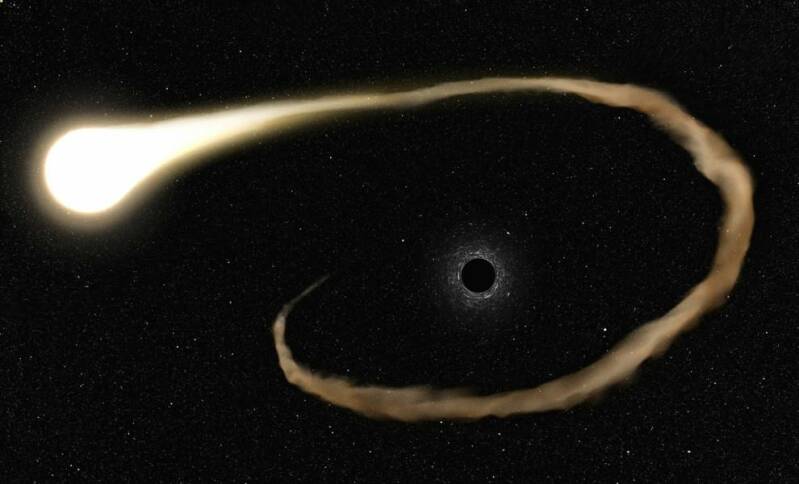
Spaghettification Explained: How Black Holes Stretch Matter
Imagine falling toward a black hole.
From a distance, nothing may seem particularly unusual. But as you get closer, the gravitational environment becomes increasingly extreme. The difference in gravity between your feet and your head begins to matter.
Your feet are closer to the black hole, so they experience a stronger gravitational pull than your head.
If that difference becomes large enough, your body begins to stretch.
This extreme stretching and compression is known as spaghettification.
But what exactly causes it? Does spaghettification happen before you reach the event horizon? Could you cross the event horizon without being torn apart? And why can a supermassive black hole actually have weaker tidal forces at its event horizon than a much smaller black hole?
Let's take a closer look.
What Is Spaghettification?
Spaghettification is the extreme stretching and compression of an object caused by tidal forces.
Near a black hole, gravity can change significantly over the length of an object. The side closest to the black hole experiences a stronger gravitational pull than the side farther away.
For a person falling feet-first toward a black hole, this means the gravitational pull on the feet can be stronger than the pull on the head.
The result is a stretching effect along the direction of the black hole and compression in other directions.
If the tidal forces become strong enough, they can overcome the forces holding the object together.
The object is stretched into an increasingly long and thin stream of matter.
That is where the term spaghettification comes from.
It is not a formal scientific term, and you do not literally turn into spaghetti. It is a memorable way of describing what extreme tidal forces can do to matter.
Key Takeaways
-
Spaghettification is caused by tidal forces, not simply by strong gravity.
-
Tidal forces occur because different parts of an object experience different gravitational pulls.
-
The effect stretches an object in one direction and compresses it in others.
-
Spaghettification does not necessarily happen at the event horizon.
-
A smaller black hole can produce extremely strong tidal forces near its event horizon.
-
A sufficiently massive black hole can have much weaker tidal forces at its event horizon.
-
Stars can also be torn apart by tidal forces in events called tidal disruption events.
-
The event horizon and spaghettification are two different physical concepts.
What Causes Spaghettification?
The most important thing to understand is that strong gravity alone does not cause spaghettification.
What matters is the difference in gravity across an object.
Imagine that you are falling toward a black hole.
Your feet are slightly closer to the black hole than your head. Because gravity becomes weaker with increasing distance, the black hole pulls more strongly on your feet than on your head.
If the difference is small, you would not notice it.
If the difference becomes enormous, the consequences become dramatic.
Your feet are accelerated more strongly toward the black hole while your head is accelerated less strongly.
The result is a stretching force along your body.
At the same time, tidal effects can compress matter in directions perpendicular to the direction of the fall.
Together, these effects are what we call spaghettification.
What Are Tidal Forces?
Tidal forces are differences in gravitational pull across an object.
We experience a much weaker version of this phenomenon on Earth.
The Moon's gravity pulls slightly more strongly on the side of Earth facing the Moon than on the opposite side. This difference contributes to Earth's tides.
The same basic principle applies near a black hole.
The closer two parts of an object are to the black hole, the greater the difference in gravitational pull between them can become.
For a small object far from a black hole, that difference may be negligible.
Closer to the black hole, it can become enormous.
Gravity vs. Tidal Forces
This distinction is important:
Gravity tells you how strongly an object is being accelerated.
Tidal forces describe how differently different parts of an object are being accelerated.
You can therefore be inside a strong gravitational field without necessarily being torn apart.
What matters for spaghettification is how rapidly the gravitational field changes across the size of the object.
That is why the mass and size of the black hole matter so much.
How Does Spaghettification Work?
Consider a one-meter-long object falling toward a black hole.
The end closest to the black hole experiences a stronger gravitational pull than the far end.
The closer end is therefore accelerated more strongly toward the black hole.
The farther end is accelerated less strongly.
As the difference increases, the object is stretched.
At the same time, tidal effects can compress the object from the sides.
The process can therefore be summarized as:
Difference in gravity → tidal forces → stretching and compression → structural failure
If the tidal forces become strong enough, the forces holding the object together can no longer resist them.
For a human body, this would eventually mean the failure of tissues and larger structures, followed by increasingly extreme effects on smaller structures.
At the most extreme stage, the object would no longer remain intact.
What Happens When You Fall Into a Black Hole?
Now imagine that you are inside a spacecraft falling toward a black hole.
From far away, the black hole may not appear to be doing anything dramatic.
You may see its effects on the surrounding environment instead.
Light from distant objects can be distorted by the black hole's gravity. Gas orbiting the black hole can move at enormous speeds, and if the black hole is actively feeding, an extremely hot and bright accretion disk may surround it.
As you continue falling, the gravitational environment becomes increasingly extreme.
Before the Event Horizon
If you are still relatively far from the black hole, the tidal forces across your body may be extremely small.
You would also be in free fall.
This is an important distinction because being in a gravitational field does not automatically mean you feel a crushing force.
Astronauts orbiting Earth are constantly falling toward Earth, yet they experience weightlessness because they and their spacecraft are falling together.
Near a black hole, however, the difference in gravitational acceleration between different parts of your body can eventually become significant.
That is when tidal forces become dangerous.
Does Spaghettification Happen Before the Event Horizon?
It can, but not necessarily.
This is one of the most important facts about spaghettification.
The event horizon is the boundary beyond which there is no path that allows an object to escape back to the outside universe.
It is not a physical surface.
There is no wall to hit and no solid shell surrounding the black hole.
Spaghettification, on the other hand, is a physical effect caused by tidal forces.
These two concepts are therefore not the same.
Around a relatively small black hole, tidal forces can become strong enough to destroy an object before it reaches the event horizon.
Around a sufficiently massive black hole, the tidal forces at the event horizon can be much weaker.
That means a falling observer could theoretically cross the event horizon before experiencing severe spaghettification.
Event Horizon vs. Spaghettification
Event HorizonSpaghettificationA boundary in spacetimeA physical effect of tidal forcesNot a solid surfaceActs on matterCrossing it means there is no route back outCan stretch and eventually destroy matterCan potentially be crossed without a dramatic physical sensationDepends on the strength of tidal forcesExists as part of the black hole's spacetime geometryDepends on the gravitational gradient across an object
This distinction is essential when talking about what happens if you fall into a black hole.
Would You Feel the Event Horizon?
For a sufficiently massive black hole, you might not notice anything dramatic at the exact moment you cross the event horizon.
The event horizon is not a physical surface.
There is no wall.
There is no material boundary.
If you were falling freely, your own clock would continue to behave normally as you crossed it.
The situation looks different to a distant observer because of relativistic effects.
This is one of the reasons black holes are so difficult to understand intuitively: what a falling observer experiences and what a distant observer sees are not necessarily the same.
Why Can a Supermassive Black Hole Be Less Violent?
This is perhaps the strangest part of spaghettification.
You might expect a larger black hole to be more destructive.
But at the event horizon, the opposite can be true.
A supermassive black hole can have much weaker tidal forces at its event horizon than a smaller black hole.
That does not mean a supermassive black hole is safe.
It means that its enormous size changes how rapidly the gravitational field varies across an object at the event horizon.
What Is a Supermassive Black Hole?
Supermassive black holes are enormous black holes found at the centers of many galaxies.
They can contain millions or even billions of times the mass of the Sun.
At the center of the Milky Way is Sagittarius A*, a supermassive black hole with a mass of roughly four million Suns.
Because a supermassive black hole has a much larger event horizon, the gravitational field can change less dramatically across the length of a human body at that boundary.
That means the event horizon itself could, in theory, be relatively uneventful for a falling observer.
Farther inside, however, the tidal forces would eventually become extreme.
Smaller vs. Supermassive Black Holes
Black holeTidal forces near event horizonPossible resultSmaller black holeCan be extremely strongSpaghettification may occur before the horizonSupermassive black holeCan be much weaker at the horizonThe horizon could potentially be crossed before severe tidal damage
So more mass does not automatically mean more spaghettification at the event horizon.
The strength of tidal forces depends on where you are relative to the black hole and how rapidly the gravitational field changes across your body.
Can You Survive Spaghettification?
No, not if the tidal forces become strong enough to cause full spaghettification.
The human body is held together by many different physical forces.
Bones, tissues, cells, molecules and atoms all have limits.
As tidal forces become stronger, increasingly large structures can begin to fail.
Eventually, the forces can become strong enough to disrupt matter on much smaller scales.
At that point, the idea of a human body no longer makes much physical sense.
There would simply be matter being stretched and pulled apart by an extreme gravitational environment.
The important distinction is that crossing an event horizon and being spaghettified are not automatically the same event.
A sufficiently large black hole could theoretically allow an observer to cross the horizon before the tidal forces become fatal.
Can Stars Be Spaghettified?
Yes.
And this is where spaghettification becomes more than a hypothetical thought experiment.
Astronomers have observed events in which stars are torn apart by black holes.
These events are called tidal disruption events, or TDEs.
A tidal disruption event occurs when a star passes sufficiently close to a black hole.
The side of the star facing the black hole experiences a stronger gravitational pull than the far side.
The star is stretched.
If the tidal forces become strong enough, they overcome the forces holding the star together.
The star is disrupted.
Some of its material can move into elongated orbits around the black hole, while other material can eventually fall inward.
The material can also become extremely hot and produce intense radiation.
That radiation gives astronomers an opportunity to study the black hole and its surroundings.
Tidal disruption events therefore provide real astronomical evidence for the extreme tidal effects associated with black holes.
Can Planets and Spacecraft Be Spaghettified?
Yes.
Any object can experience tidal forces.
The important question is whether those forces become strong enough to overcome the forces holding the object together.
A spacecraft is no exception.
As it approaches a black hole, different parts of the spacecraft experience slightly different gravitational accelerations.
The resulting stresses could deform the spacecraft.
Connections could fail.
The hull could be damaged.
Eventually, if the tidal forces become strong enough, the spacecraft could be pulled apart.
A planet could suffer a similar fate.
If a planet passes sufficiently close to a black hole, tidal forces can stretch and deform it and eventually destroy it.
The exact outcome depends on factors including the object's size, the black hole's mass and the object's trajectory.
Black Holes Are Not Cosmic Vacuum Cleaners
There is a common misconception that black holes simply suck everything into them.
They do not.
A black hole's gravitational influence depends on its mass and distance, just as the gravitational influence of other massive objects does.
If the Sun were magically replaced by a black hole with exactly the same mass, Earth would continue orbiting at roughly the same distance.
The immediate problem would be the disappearance of sunlight, not Earth suddenly being sucked into the black hole.
Black holes become particularly extreme when you get close to them.
That is where the rapid change in gravitational strength across an object can produce enormous tidal forces.
What Happens After Spaghettification?
Once an object has been torn apart, its matter continues moving through the gravitational environment around the black hole.
Some material may fall inward.
Some may enter elongated orbits.
If other gas and matter are present, the disrupted material can interact with them.
Collisions and other processes can heat the material to extremely high temperatures, potentially producing intense radiation.
Eventually, some of the matter may cross the event horizon.
After crossing that boundary, it cannot return to the outside universe.
But what happens deeper inside the black hole is much less certain.
What Is at the Center of a Black Hole?
According to classical general relativity, gravitational collapse leads toward a singularity.
In simple terms, a singularity is a region where the mathematical description of spacetime reaches conditions that the theory cannot describe in the usual way.
But this does not necessarily mean that we know exactly what physically exists at the center of a black hole.
General relativity is extraordinarily successful at describing gravity and large-scale structures.
Quantum mechanics is extraordinarily successful at describing matter and energy at very small scales.
Under the extreme conditions inside a black hole, both descriptions become relevant.
A complete theory of quantum gravity may ultimately be needed to explain what happens in the deepest regions of a black hole.
For now, this remains one of the major unanswered questions in physics.
How Close Do You Have to Get for Spaghettification?
There is no single distance at which spaghettification begins.
It depends on several factors.
The mass of the black hole is particularly important.
A smaller black hole can produce extremely strong tidal forces near its event horizon.
A supermassive black hole can have much weaker tidal forces at its event horizon because the horizon is much farther from the center.
The size of the object also matters.
A larger object spans a greater distance through the gravitational field, so different parts of it can experience a larger difference in gravitational acceleration.
The object's trajectory also matters.
So there is no universal "spaghettification distance."
A better way to think about it is:
Spaghettification becomes important when the tidal forces across an object become strong enough to overcome the forces holding that object together.
Is Spaghettification Real?
The physics behind spaghettification follows from our understanding of gravity, tidal forces and general relativity.
We have not directly watched a human being fall into a black hole.
But astronomers have observed stars being stretched and destroyed by black holes in tidal disruption events.
These observations show that black holes can produce extreme tidal effects capable of dramatically distorting and destroying stars.
Astronomers have also observed other phenomena associated with black holes, including powerful radiation from matter surrounding them and gravitational waves produced by merging black holes.
So while nobody has directly observed a human being being spaghettified, the underlying physical process is not science fiction.
It is a consequence of established gravitational physics.
Spaghettification and General Relativity
To understand black holes more deeply, we eventually arrive at Albert Einstein's general theory of relativity.
Published in 1915, general relativity describes gravity differently from the simple picture of an invisible force pulling objects toward one another.
Instead, mass and energy affect the geometry of spacetime.
A black hole is an extreme example of this curved spacetime.
As you move through the gravitational environment around a black hole, the difference in gravitational acceleration across an object can become increasingly important.
That difference produces tidal forces.
And when those tidal forces become extreme enough, spaghettification can occur.
The process is therefore not the result of some special "black hole force."
It is an extreme consequence of the same gravitational physics that operates throughout the universe.
Frequently Asked Questions About Spaghettification
What is spaghettification?
Spaghettification is the extreme stretching and compression of matter caused by tidal forces. Near a black hole, the difference in gravitational pull across an object can become strong enough to stretch and eventually destroy it.
Why does spaghettification happen?
It happens because different parts of an object experience different gravitational pulls. The side closest to the black hole is pulled more strongly than the side farther away, creating tidal forces.
Do you actually become spaghetti?
No. Spaghettification is a descriptive term. It refers to matter being stretched into a long, thin shape by extreme tidal forces.
Does spaghettification happen before the event horizon?
It can. Around a smaller black hole, tidal forces may become strong enough to destroy an object before it reaches the event horizon. Around a sufficiently massive black hole, the event horizon may be crossed before severe tidal forces occur.
Can you survive crossing the event horizon?
In theory, an observer could cross the event horizon of a sufficiently large black hole without being immediately destroyed by tidal forces. However, crossing the event horizon means there is no route back to the outside universe.
Which black holes cause the strongest spaghettification?
It depends on where the object is relative to the black hole. Smaller black holes can produce extremely strong tidal forces near their event horizons, while supermassive black holes can have weaker tidal forces at their horizons.
Can stars be spaghettified?
Yes. Stars that pass too close to black holes can be stretched and torn apart in events known as tidal disruption events.
Can planets be spaghettified?
Yes. If a planet gets sufficiently close to a black hole, tidal forces can stretch, deform and eventually destroy it.
Can spacecraft be spaghettified?
Yes. A spacecraft experiences tidal forces just like any other object. If those forces become strong enough, the spacecraft could deform and eventually be pulled apart.
How long does spaghettification take?
There is no single answer. The timescale depends on the black hole's mass, the object's size and its trajectory. Near a smaller black hole, the process could become extremely rapid. Near a sufficiently massive black hole, an observer could potentially cross the event horizon before experiencing the strongest tidal forces.
Is spaghettification scientifically supported?
Yes. The underlying process follows from general relativity and the physics of tidal forces. Astronomers have also observed tidal disruption events in which stars are torn apart by black holes.
The Strange Physics of Spaghettification
Spaghettification sounds almost humorous because of its unusual name.
The physics behind it is anything but humorous.
It is an extreme example of what happens when gravity changes dramatically across an object.
A black hole does not need to "suck" an object into itself to destroy it. Instead, its gravitational field can become so different from one side of the object to the other that the object can no longer remain intact.
And the strangest part is that the event horizon itself is not necessarily where the destruction happens.
For a smaller black hole, tidal forces can become lethal before the horizon is reached.
For a sufficiently massive black hole, the horizon can potentially be crossed without an immediate dramatic sensation.
Farther inside, however, the tidal forces can eventually become extreme.
That distinction between the event horizon and spaghettification is one of the most important ideas to understand when thinking about falling into a black hole.
We know that black holes exist. We have observed their effects on stars, gas and light, detected gravitational waves from merging black holes and observed stars being disrupted by their enormous gravitational fields.
But we still do not know exactly what happens in the deepest regions inside a black hole.
That is what makes spaghettification more than just a strange story about what happens when you fall into a black hole.
It is a reminder that the universe can push familiar laws of physics into conditions far beyond anything we experience on Earth.
Add comment
Comments