

Written by Francois Hoogstrate
Last update: 11-08-2026
Quick Answer
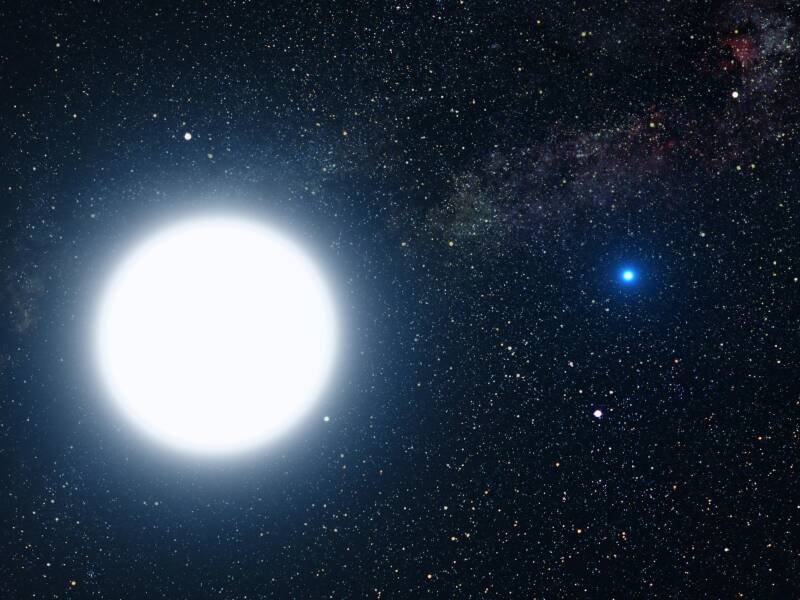
A white dwarf is the remaining core of a star that was roughly the same mass as the Sun. After the star has exhausted its nuclear fuel, it sheds its outer layers into space. What remains is an extremely compact, hot stellar core that no longer produces energy through nuclear fusion but continues to radiate stored heat for billions of years. Although a white dwarf is about the size of Earth, it can contain nearly as much mass as the Sun, making it one of the densest objects in the universe.
Table of Contents
- What Is a White Dwarf?
- Key Takeaways
- How Does a White Dwarf Form?
- The Life Cycle of a Star
- Why Is It Called a White Dwarf?
- How Big Is a White Dwarf?
- How Massive Is a White Dwarf?
- Why Are White Dwarfs So Dense?
- The Physics Behind White Dwarfs
- Famous Examples of White Dwarfs
- Part 2: Temperature, Lifespan, Supernovae, Black Dwarfs, and More
Key Takeaways
- A white dwarf is the leftover core of a Sun-like star.
- It no longer produces energy through nuclear fusion.
- It is roughly the same size as Earth.
- It can contain nearly as much mass as the Sun.
- A single teaspoon of white dwarf material would weigh thousands of tons on Earth.
- White dwarfs cool down extremely slowly over billions of years.
- Our Sun will eventually become a white dwarf in about five billion years.
- White dwarfs are among the densest objects in the universe.
What Is a White Dwarf?
A white dwarf is one of the most fascinating objects in the universe. Although its name might suggest a small star, a white dwarf is actually the remnant of a dead star.
Stars do not live forever. Like living organisms, they have a beginning, a long period of stability, and eventually reach the end of their lives. For stars with a mass of up to about eight times that of our Sun, the final stage is a white dwarf.
When such a star runs out of nuclear fuel, dramatic changes occur within its core. The star can no longer generate enough energy through nuclear fusion to counteract gravity. Eventually, it expels its outer layers into space, leaving only the incredibly dense core behind.
That leftover core is what astronomers call a white dwarf.
Despite its relatively small size, a white dwarf still contains an enormous amount of mass. As a result, the gravity at its surface is hundreds of thousands of times stronger than Earth's.
White dwarfs are also the final destination for approximately 97% of all stars in the Milky Way, including our own Sun.


How Does a White Dwarf Form?
To understand how a white dwarf forms, we first need to understand the life cycle of an average star.
Most stars are made primarily of hydrogen.
Inside the stellar core, hydrogen atoms fuse together to form helium.
This process is called nuclear fusion.
Nuclear fusion releases enormous amounts of energy.
That energy is what allows stars to shine and produce heat.
For millions or even billions of years, two powerful forces remain in balance:
- Gravity, which tries to pull the star inward.
- Energy from nuclear fusion, which pushes outward.
As long as these two forces remain balanced, the star stays stable.
Eventually, however, the supply of hydrogen begins to run out.
The star then starts fusing helium and, depending on its mass, even heavier elements.
For stars like our Sun, this process eventually comes to an end.
The Red Giant Phase
Once most of the hydrogen fuel has been consumed, the star undergoes dramatic changes.
Its outer layers begin to expand enormously.
The star can grow hundreds of times larger than it was during its main-sequence lifetime.
Astronomers call this stage a red giant.
Our own Sun is expected to enter the red giant phase in approximately five billion years.
During this period, it will almost certainly engulf Mercury and Venus.
Whether Earth survives remains uncertain, but it would almost certainly become completely uninhabitable.
The Planetary Nebula
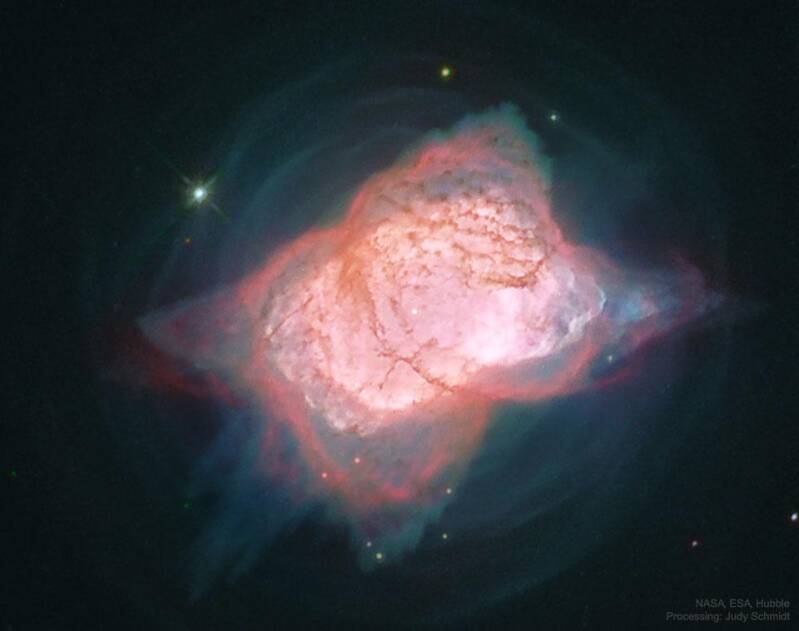
Near the end of the red giant stage, the star gently ejects its outer layers into space.
This creates a beautiful cloud of glowing gas known as a planetary nebula.
The name is somewhat misleading.
Planetary nebulae have nothing to do with planets.
Early astronomers gave them this name because these glowing clouds resembled the disks of distant planets when viewed through early telescopes.
In reality, they are expanding shells of gas produced by dying stars.
The Remaining Core
Once the outer layers have disappeared, only the stellar core remains.
This core has exhausted the nuclear fuel needed for fusion.
However, it remains incredibly hot.
Its surface temperature can initially exceed 100,000 degrees Celsius.
At this point, the object is officially classified as a white dwarf.
The Life Cycle of a Star


The life of a typical Sun-like star follows a predictable sequence.
Step 1: A Giant Cloud of Gas
Everything begins inside a massive cloud of hydrogen gas and cosmic dust.
Gravity slowly pulls this material together.
After millions of years, a young star is born.
Step 2: Main Sequence Star
This is by far the longest stage of a star's life.
Our Sun is currently in this phase.
Hydrogen continuously fuses into helium.
This stable period lasts for billions of years.
Step 3: Red Giant
As hydrogen becomes depleted, the star expands dramatically.
Its surface temperature decreases slightly, giving it a reddish appearance.
Step 4: Planetary Nebula
The star sheds its outer atmosphere.
Only the hot central core remains.
Step 5: White Dwarf
The remaining core slowly cools over billions of years.
No new nuclear fusion takes place.
It simply radiates away the heat stored during its active lifetime.
Why Is It Called a White Dwarf?
Many people assume that all white dwarfs are literally white.
That is not entirely correct.
Young white dwarfs are incredibly hot.
Their surface temperatures typically range from 25,000°C to well over 100,000°C.
At such extreme temperatures, they emit mostly white or bluish-white light.
As billions of years pass, they gradually cool.
Their color slowly shifts from white toward yellow, then reddish, and eventually becomes so dim that they would appear almost black.
Because this cooling process takes far longer than the current age of the universe, no fully cooled white dwarfs exist today.
We'll explore this fascinating topic further in Part 2.
How Big Is a White Dwarf?
One of the most remarkable characteristics of a white dwarf is its size.
Although it may contain almost as much mass as the Sun, it is only about as large as Earth.
Its average diameter ranges between 10,000 and 15,000 kilometers (6,200–9,300 miles).
For comparison:
- Earth has a diameter of approximately 12,742 kilometers.
- The Sun has a diameter of nearly 1.4 million kilometers.
This means a white dwarf is roughly 100 times smaller than the Sun.
Yet it still contains nearly the same amount of matter.
That incredible compression is what makes white dwarfs so extraordinary.
Why Are White Dwarfs So Small?
When nuclear fusion stops, the outward pressure supporting the star disappears.
Gravity immediately begins compressing the remaining core.
Only a remarkable quantum mechanical effect prevents the star from collapsing completely.
This phenomenon is called electron degeneracy pressure.
We'll explain this concept in more detail shortly.
How Massive Is a White Dwarf?
Despite their relatively small size, white dwarfs are anything but lightweight.
Most have masses ranging between:
- 0.5 solar masses
- 1.4 solar masses
The upper limit of approximately 1.4 times the Sun's mass is extremely important.
It is known as the Chandrasekhar Limit.
If a white dwarf exceeds this limit, it can no longer remain stable.
Under certain circumstances, this can trigger one of the most spectacular explosions in the universe—a supernova—which will be discussed in Part 2.
Why Are White Dwarfs So Dense?
Density is perhaps the most astonishing characteristic of a white dwarf.
Imagine compressing the entire mass of the Sun into an object roughly the size of Earth.
That is essentially what a white dwarf is.
The result is an incredibly dense object.
A sugar cube-sized piece of white dwarf material would weigh hundreds of kilograms to several tons on Earth.
A single teaspoon would weigh thousands of tons.
This makes white dwarfs among the densest known objects in the universe that have not collapsed into neutron stars or black holes.
A Simple Analogy
Imagine a large sports stadium filled with 50,000 people.
Now imagine trying to fit those same 50,000 people into an average living room.
While this comparison isn't physically accurate, it gives a sense of just how tightly matter is packed inside a white dwarf.
The Physics Behind White Dwarfs
On Earth, solid objects are supported because atoms resist being squeezed together.
Inside a white dwarf, things work very differently.
The pressure is so immense that ordinary atomic structures can no longer exist.
Electrons are forced into extremely close proximity.
According to quantum mechanics, however, no two electrons can occupy exactly the same quantum state.
This creates a powerful outward pressure known as electron degeneracy pressure.
It is this remarkable quantum effect that prevents a white dwarf from collapsing further under its own immense gravity.
Few objects in the universe demonstrate the power of quantum mechanics as beautifully as white dwarfs.
Famous Examples of White Dwarfs
Although white dwarfs are relatively small, astronomers have now identified hundreds of thousands of them.
Some have become especially famous because they are close to Earth or have significantly advanced our understanding of stellar evolution.
In Part 2, we'll explore:
- Sirius B
- Procyon B
- Van Maanen's Star
- How white dwarfs are discovered
- How hot white dwarfs really are
- How long they survive
- Why black dwarfs do not yet exist
- Type Ia supernovae
- The Chandrasekhar Limit in greater detail
- Fascinating facts and frequently asked questions
How Do Astronomers Discover White Dwarfs?
Although white dwarfs are among the most common endpoints of stellar evolution, they are surprisingly difficult to observe. Because they are relatively small and no longer generate energy through nuclear fusion, they emit far less light than ordinary stars. Instead, they slowly radiate the residual heat stored during their active lifetimes.
Modern telescopes, however, have made it possible to detect and study white dwarfs in remarkable detail. Astronomers use several techniques to identify these stellar remnants.


Measuring Brightness
Every star emits light, and the amount of light it produces reveals important information about its size and temperature.
White dwarfs are extremely hot, but because they have such a small surface area, they are much less luminous than stars like the Sun. By comparing a star's brightness with its temperature, astronomers can determine whether it is a compact object such as a white dwarf.
Spectroscopy
Another essential technique is spectroscopy.
In spectroscopy, the light from a star is separated into different wavelengths, much like a rainbow.
Every chemical element leaves a unique fingerprint in the resulting spectrum. By analyzing these spectral lines, scientists can determine the chemical composition of a white dwarf.
Most white dwarfs have atmospheres composed primarily of:
- Hydrogen
- Helium
- Small amounts of carbon, oxygen, or heavier elements
These observations provide valuable clues about the star's past and its evolutionary history.
The Gaia Mission
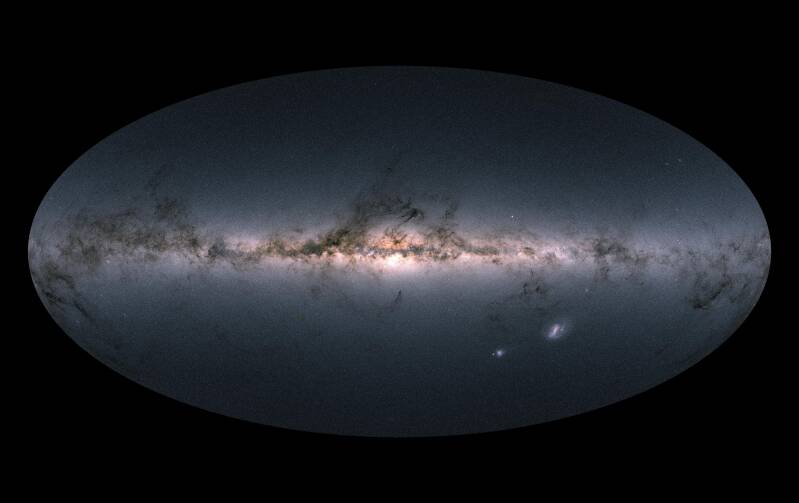
One of the biggest breakthroughs in recent years came from the European Space Agency's Gaia spacecraft.
Gaia has measured the positions, distances, and motions of more than a billion stars with extraordinary precision.
As a result, astronomers have identified hundreds of thousands of white dwarfs throughout the Milky Way.
Each new discovery helps scientists better understand how stars evolve and how our galaxy has changed over billions of years.

How Hot Is a White Dwarf?
The temperature of a white dwarf depends largely on its age.
Immediately after the outer layers of the original star have been expelled, the remaining core is extraordinarily hot.
Its surface temperature can exceed:
- 100,000°C
- In some cases, more than 150,000°C
To put that into perspective:
ObjectApproximate Surface TemperatureLava1,200°CThe Sun5,500°CYoung White Dwarf100,000°C or more
Despite these extreme temperatures, a white dwarf is no longer an active star.
No nuclear fusion takes place.
Instead, it slowly releases the heat accumulated during billions of years of stellar evolution.
Why Do White Dwarfs Cool So Slowly?
You might expect such a small object to cool quickly.
Surprisingly, the opposite is true.
Several factors explain this incredibly slow cooling process.
An Enormous Thermal Reservoir
During its active lifetime, the original star generated enormous amounts of energy.
A significant portion of that energy remains trapped inside the compact stellar core.
Extraordinary Density
Because the matter inside a white dwarf is compressed to such extreme densities, heat escapes only very gradually.
This allows the white dwarf to remain hot for billions of years.
A Thin Atmosphere
Unlike planets such as Earth, white dwarfs possess only a very thin outer atmosphere.
Heat is therefore transferred differently, contributing to their exceptionally long cooling times.
The result is remarkable.
Some white dwarfs will remain warm for tens of billions of years, and many will continue cooling long after our galaxy has changed dramatically.
How Long Does a White Dwarf Live?
In a sense, a white dwarf never truly dies.
Instead, it gradually becomes cooler and dimmer over unimaginable periods of time.
Astronomers generally describe this cooling process in several stages.
Stage 1
A newly formed white dwarf.
Surface temperatures exceed 100,000°C.
It shines with bright white or bluish-white light.
Stage 2
After several billion years.
Its temperature slowly decreases.
It remains clearly visible through telescopes.
Stage 3
After tens of billions of years.
The white dwarf becomes cooler and much less luminous.
It emits progressively less visible light.
Stage 4
After trillions of years.
Nearly all stored heat has been radiated away.
The object would eventually become what astronomers call a black dwarf.
What Is a Black Dwarf?
A black dwarf represents the theoretical final stage in the evolution of a white dwarf.
Once all of its remaining heat has dissipated, it no longer emits significant visible light.
At that point, it becomes a cold, dark stellar remnant.
Interestingly, no black dwarfs are believed to exist today.
Why Don't Black Dwarfs Exist Yet?
The universe is approximately 13.8 billion years old.
Although that sounds unimaginably old, it is still far too young for any white dwarf to have cooled completely.
Current calculations suggest that complete cooling requires:
- Hundreds of billions of years
- Trillions of years
- Possibly even longer
As a result, every white dwarf that has ever formed is still cooling.
Black dwarfs therefore remain purely theoretical objects—for now.
They are among the few astronomical objects predicted by physics that have never been directly observed.
What Is a White Dwarf Made Of?
The composition of a white dwarf depends largely on the original star from which it formed.
Carbon and Oxygen White Dwarfs
The vast majority of white dwarfs consist primarily of carbon and oxygen.
Astronomers expect our Sun to eventually leave behind this type of white dwarf.
Helium White Dwarfs
Some lower-mass stars produce white dwarfs whose cores are dominated by helium.
These objects are less common but still play an important role in stellar evolution studies.
Oxygen-Neon-Magnesium White Dwarfs
More massive stars can produce white dwarfs composed mainly of oxygen, neon, and magnesium.
Although relatively rare, these stellar remnants provide valuable insight into the final evolutionary stages of intermediate-mass stars.
Understanding the Chandrasekhar Limit
Earlier, we briefly introduced the Chandrasekhar Limit, one of the most important concepts in astrophysics.
In the 1930s, Indian astrophysicist Subrahmanyan Chandrasekhar demonstrated that a white dwarf cannot support unlimited mass.
Its maximum stable mass is approximately:
1.4 times the mass of the Sun.
If a white dwarf gains additional material—for example, from a nearby companion star—it may eventually exceed this limit.
When that happens, electron degeneracy pressure can no longer resist gravity.
The star becomes unstable.
This instability often leads to one of the most spectacular events in the cosmos.
A supernova.
What Happens If a White Dwarf Becomes Too Massive?
Many stars exist in binary star systems, where two stars orbit one another.
If one of those stars becomes a white dwarf while its companion continues evolving, the white dwarf may begin pulling gas from the neighboring star.
Over time, its mass gradually increases.
If it eventually exceeds the Chandrasekhar Limit, catastrophic changes occur.
Temperatures and pressures rise dramatically.
Within seconds, an enormous explosion can occur.
This event is known as a:
Type Ia Supernova
During a Type Ia supernova, the white dwarf is typically destroyed completely.
Unlike some other stellar explosions, little or nothing remains afterward.


Why Are Type Ia Supernovae So Important?
Type Ia supernovae are among the brightest explosions in the universe.
For a short period, they can outshine an entire galaxy.
This extraordinary brightness makes them invaluable to astronomers.
Because these explosions reach nearly the same peak brightness, scientists use them as standard candles to measure vast cosmic distances.
Observations of Type Ia supernovae played a crucial role in one of the greatest discoveries in modern astronomy:
The realization that the expansion of the universe is accelerating, leading to the concept of dark energy.
Famous White Dwarfs
Over the years, several white dwarfs have become especially important to astronomical research.
Sirius B
Sirius is the brightest star visible in Earth's night sky.
However, Sirius is actually a binary system.
Its companion, Sirius B, is one of the most famous white dwarfs ever discovered.
Despite being only about the size of Earth, Sirius B has nearly the same mass as the Sun.
Its discovery provided strong evidence that stars could end their lives as incredibly dense remnants.


Procyon B
Another well-known example is Procyon B.
This white dwarf orbits the bright star Procyon A.
By studying the orbital motion of these two stars, astronomers have accurately measured the mass, density, and gravitational properties of white dwarfs.
Van Maanen's Star
Van Maanen's Star is one of the closest solitary white dwarfs to Earth.
It has attracted considerable scientific attention because astronomers detected heavy elements in its atmosphere.
These elements likely originated from asteroids or planetary debris that fell onto the white dwarf.
This discovery suggests that planetary systems may survive, at least partially, after their parent stars die.
Can White Dwarfs Have Planets?
For many years, astronomers believed that planetary systems were completely destroyed when their stars entered the red giant phase.
Today, evidence suggests a more complicated picture.
Some planets may survive.
Asteroids, comets, and debris disks can also remain in orbit.
Over time, some of this material drifts toward the white dwarf.
The star's immense gravity tears these objects apart.
The resulting debris settles onto the white dwarf's surface, allowing astronomers to analyze the chemical composition of ancient planetary material.
This rapidly developing field offers fascinating insights into the long-term fate of planetary systems—including our own Solar System.
Will Our Sun Become a Supernova?
No.
This is one of the most common misconceptions in astronomy.
The Sun simply does not contain enough mass.
Instead, its future is expected to follow this sequence:
- Main-sequence star
- Red giant
- Planetary nebula
- White dwarf
Only much more massive stars end their lives as supernovae before becoming neutron stars or black holes.
Fortunately, our Sun will never explode as a supernova.
White Dwarfs vs. Other Objects in the Universe
White dwarfs are often mentioned alongside neutron stars and black holes because all three represent the final stages in the lives of stars. However, these celestial objects are vastly different in terms of their formation, structure, density, and behavior.
Understanding these differences makes it easier to appreciate just how unique white dwarfs really are.
White Dwarf vs. a Main-Sequence Star
A main-sequence star, such as our Sun, generates energy through nuclear fusion. Inside its core, hydrogen atoms fuse into helium, producing the light and heat that allow the star to shine for billions of years.
A white dwarf, on the other hand, no longer produces energy through fusion.
Its nuclear reactions have completely stopped.
Instead, it slowly radiates away the heat stored during its previous life as an active star.
Key Differences
Main-Sequence StarWhite DwarfNuclear fusion is activeNo nuclear fusionContinuously generates new energyRadiates stored heatMuch larger in sizeApproximately the size of EarthLower average densityExtremely dense
Although both objects are technically stars at different stages of evolution, their physical properties are dramatically different.
White Dwarf vs. Neutron Star
If a star is significantly more massive than the Sun, it does not end its life as a white dwarf.
Instead, after a massive supernova explosion, it may become a neutron star.
Neutron stars are even more compact than white dwarfs.
While a white dwarf has a diameter comparable to Earth's—around 12,000 kilometers (7,500 miles)—a neutron star is typically only about 20 kilometers (12 miles) across.
Despite this tiny size, a neutron star often contains more mass than the Sun.
This makes neutron stars even denser than white dwarfs.
Comparison
White DwarfNeutron StarDiameter of about 12,000 kmDiameter of about 20 kmSupported by electron degeneracy pressureSupported by neutron degeneracy pressureForms from Sun-like starsForms from much more massive starsDoes not require a supernovaUsually forms after a supernova
The difference in density is staggering. A teaspoon of neutron star material would weigh billions of tons, far exceeding the already incredible density of a white dwarf.
White Dwarf vs. Black Hole
Black holes represent the final stage of the most massive stars.
When gravity overwhelms every known force resisting collapse, the stellar core continues collapsing until a black hole forms.
The defining feature of a black hole is its event horizon—a boundary beyond which nothing, not even light, can escape.
A white dwarf is very different.
Although its gravity is immensely strong compared to Earth's, it is nowhere near powerful enough to trap light.
Because of this, white dwarfs remain directly observable with telescopes.
They shine because of their residual heat rather than ongoing nuclear fusion.
What Is the Future of Our Sun?
One of the most fascinating aspects of white dwarfs is that they reveal the future of our own Solar System.
Astronomers are highly confident that the Sun will eventually become a white dwarf.
Its evolution is expected to follow this timeline.
Today
The Sun is a stable main-sequence star.
It continuously converts hydrogen into helium within its core.
This process has been ongoing for approximately 4.6 billion years.
In About Five Billion Years
Most of the hydrogen in the Sun's core will be exhausted.
The Sun will expand enormously and become a red giant.
Its outer layers will extend far beyond their current size.
The Planetary Nebula Stage
Eventually, the Sun will shed its outer atmosphere.
These expanding gases will create a spectacular planetary nebula visible across vast distances.
Although beautiful, this stage will be relatively short compared to the Sun's overall lifetime.
The White Dwarf Stage
After the outer layers disperse, only the hot stellar core will remain.
This core will become a white dwarf.
For billions—and eventually trillions—of years, it will slowly cool while orbiting the center of the Milky Way.
What Will Happen to Earth?
People often wonder whether Earth will survive the Sun's transformation into a white dwarf.
Current scientific models suggest that long before the Sun reaches this stage, Earth will no longer be capable of supporting life.
As the Sun expands into a red giant:
- Surface temperatures on Earth will rise dramatically.
- The oceans will evaporate.
- Much of the atmosphere will disappear.
- Complex life will become impossible.
Some models suggest that the expanding Sun may eventually engulf Earth entirely.
Others indicate that Earth could survive but become a scorched, lifeless world orbiting a cooling white dwarf.
Either way, our planet's future is closely tied to the life cycle of the Sun.
Why Do Astronomers Study White Dwarfs?
White dwarfs are far more than simply the remnants of dead stars.
They serve as natural laboratories for understanding the universe.
By studying white dwarfs, astronomers can learn about:
- How stars are born
- How stars evolve
- How stars die
- The evolution of planetary systems
- The chemical history of our galaxy
- The ages of star clusters
- The long-term future of the Milky Way
One particularly valuable characteristic of white dwarfs is that they cool in a highly predictable way.
Because of this, astronomers can estimate the ages of star clusters by measuring the temperatures of their white dwarfs.
This technique is known as white dwarf cooling chronology and has become an important tool in modern astrophysics.
Fascinating Facts About White Dwarfs
White dwarfs continue to surprise scientists with their remarkable properties.
Here are some of the most interesting facts.
1. Most Stars Become White Dwarfs
Approximately 97% of all stars in the Milky Way will eventually end their lives as white dwarfs.
This makes them the most common stellar remnants in our galaxy.
2. They're About the Size of Earth
Despite containing nearly as much mass as the Sun, a typical white dwarf is only about the size of our planet.
This extreme compression is one of the reasons they are so dense.
3. They Remain Hot for Billions of Years
White dwarfs cool extraordinarily slowly.
Many of the white dwarfs we observe today formed billions of years ago and are still radiating significant amounts of heat.
4. They No Longer Produce Energy
Unlike ordinary stars, white dwarfs generate no new energy through nuclear fusion.
Everything they emit comes from heat stored during their earlier evolutionary stages.
5. Their Gravity Is Incredible
The gravitational pull at the surface of a white dwarf is hundreds of thousands of times stronger than Earth's.
A human could never survive under such extreme conditions.
6. Some White Dwarfs Rotate Extremely Fast
While many white dwarfs rotate relatively slowly, others complete an entire rotation in only a few minutes.
Their rapid spin provides astronomers with valuable information about stellar evolution and angular momentum.
7. White Dwarfs Can Reveal Ancient Planets
By studying the heavy elements found in a white dwarf's atmosphere, scientists can reconstruct the composition of rocky planets and asteroids that once orbited the original star.
This allows astronomers to study planetary systems that no longer exist.
Frequently Asked Questions (FAQ)
Is a White Dwarf Still a Star?
Yes—although not in the traditional sense.
A white dwarf is the remaining core of a star after nuclear fusion has ended.
Because it no longer generates new energy, astronomers often refer to it as a stellar remnant rather than an active star.
How Old Can a White Dwarf Become?
Much older than the current universe.
White dwarfs are expected to survive for hundreds of billions—or even trillions—of years before cooling into theoretical black dwarfs.
Could a Human Land on a White Dwarf?
No.
Its gravity is far too strong, and its surface consists of matter compressed under enormous pressure.
Even if the temperature were low enough, the physical conditions would be fatal.
Are White Dwarfs Dangerous?
Not directly.
White dwarfs pose no threat to Earth.
However, a white dwarf in a binary system can become extremely dangerous if it accumulates enough material from its companion star to trigger a Type Ia supernova.
Can White Dwarfs Explode?
Yes.
If a white dwarf exceeds the Chandrasekhar Limit after gaining additional mass, it can explode as a Type Ia supernova.
These explosions rank among the brightest events in the universe.
How Many White Dwarfs Exist?
Astronomers estimate that the Milky Way alone contains billions of white dwarfs.
Hundreds of thousands have already been identified, and new discoveries continue every year thanks to increasingly powerful telescopes.
Can You See a White Dwarf Without a Telescope?
Generally, no.
Because white dwarfs are relatively faint and very small, they are difficult to observe with the naked eye.
Some, such as Sirius B, orbit bright stars but cannot be distinguished without advanced instruments.
Why Are White Dwarfs Important?
White dwarfs are essential for understanding stellar evolution.
They help astronomers estimate the ages of star clusters, study the evolution of galaxies, investigate the fate of planetary systems, and measure enormous cosmic distances through Type Ia supernovae.
Conclusion
White dwarfs may be small in size, but they play an enormous role in our understanding of the universe.
They are the compact remnants of stars that have exhausted their nuclear fuel and shed their outer layers. Despite being only about the size of Earth, they can contain nearly as much mass as the Sun, making them some of the densest objects known in the cosmos.
Unlike ordinary stars, white dwarfs no longer generate energy through nuclear fusion. Instead, they slowly release the heat stored during billions of years of stellar evolution. Their gradual cooling process is so slow that not a single white dwarf has had enough time to become a black dwarf since the universe began.
For astronomers, white dwarfs are invaluable. They provide insights into stellar evolution, help determine the ages of star clusters, reveal the history of planetary systems, and even allow scientists to measure distances across the universe through Type Ia supernovae.
Perhaps most fascinating of all, white dwarfs offer a glimpse into the distant future of our own Solar System. Billions of years from now, our Sun is expected to follow the same path, eventually becoming a white dwarf itself.
Whether you are new to astronomy or have a long-standing interest in the cosmos, white dwarfs demonstrate that even after a star has reached the end of its active life, it can continue to shape our understanding of the universe for billions of years to come.
Want to Learn More?
Are you fascinated by space exploration, astronomy, and the greatest mysteries of our universe?
Follow our blog for more in-depth articles about NASA, historic space missions, scientific discoveries, and the facts behind the most discussed stories from space.
Stay informed about the latest developments as well as the fascinating mysteries that the universe still has waiting for us.
Francois Hoogstrate
Founder & Editor of DeepSpaceJournal
Francois Hoogstrate researches and writes about astronomy, NASA missions, cosmology, planetary science, and space exploration. His articles focus on presenting complex scientific topics in a clear, balanced, and accessible way, using information from official space agencies, scientific publications, and historical sources.
Sources & References
NASA – White Dwarfs (NASA Science)
NASA – The Life Cycle of Stars
NASA – Hubble Space Telescope: White Dwarf Research
European Space Agency (ESA) – Gaia Mission: Mapping the Milky Way
European Space Agency (ESA) – Stellar Evolution Research
European Space Agency (ESA) – Gaia Data and White Dwarf Studies
NASA Astrophysics Data System (ADS) – Scientific Literature Database
SIMBAD Astronomical Database – Stellar Data and White Dwarf Catalogs
OpenStax – Astronomy 2e: The Evolution of Stars
Cambridge University Press – An Introduction to Modern Astrophysics
Research Papers
Chandrasekhar, S. (1931). The Maximum Mass of Ideal White Dwarfs.
https://doi.org/10.1086/143324
Hamada, T., & Salpeter, E. E. (1961). Models for Zero-Temperature Stars.
https://doi.org/10.1086/147195
Fontaine, G., Brassard, P., & Bergeron, P. (2001). The Potential of White Dwarf Cosmochronology.
https://doi.org/10.1086/319535
Riess, A. G., et al. (1998). Observational Evidence from Supernovae for an Accelerating Universe and a Cosmological Constant.
https://doi.org/10.1086/300499
Zuckerman, B., et al. (2007). The Chemical Composition of an Extrasolar Minor Planet.
https://doi.org/10.1086/522223
Winget, D. E., et al. (1987). An Independent Method for Determining the Age of the Galaxy.
https://doi.org/10.1086/184821
Isern, J., García-Berro, E., & Salaris, M. (1998). Evolution of White Dwarfs and Galactic Chronology.
https://doi.org/10.1051/aas:1998311
Add comment
Comments