

Written by Francois Hoogstrate
Last update: 30-07-2026
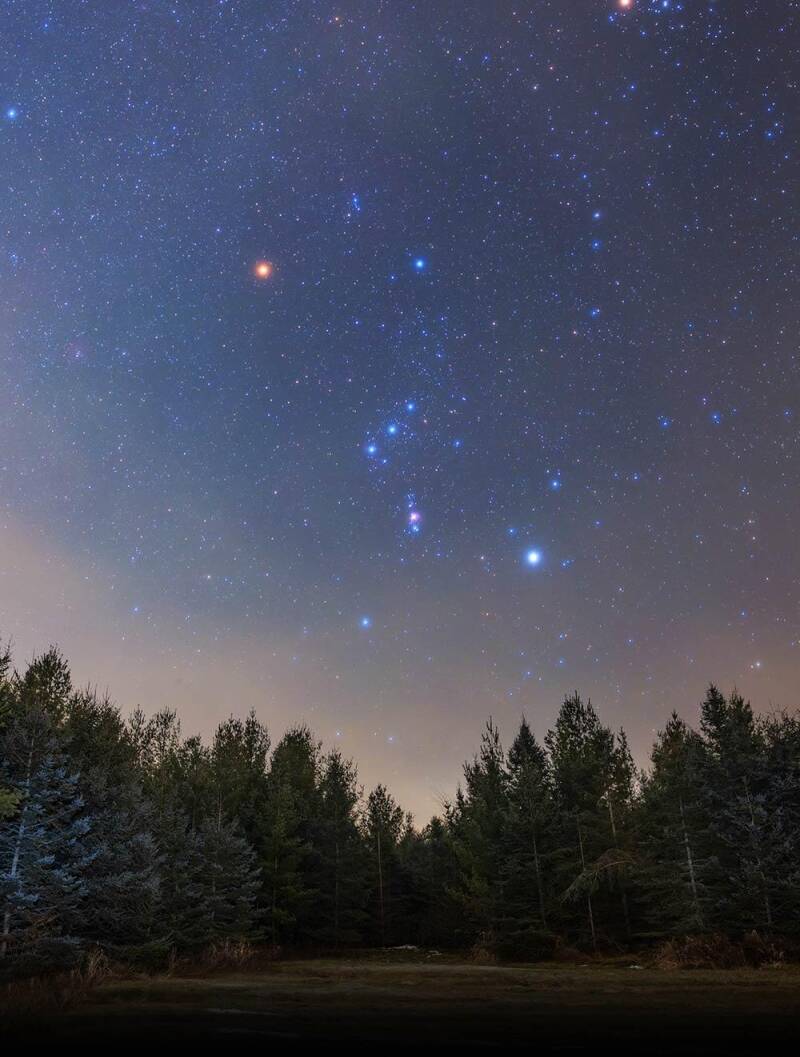
What Happens When Betelgeuse Explodes? Everything You Need to Know About the Future Supernova of Betelgeuse
Imagine looking up at the night sky and suddenly seeing a new incredibly bright object shining among the stars. It is not a planet, a satellite, or a comet. It is a massive star hundreds of light-years away ending its life in one of the most powerful events in the universe.
This is exactly what astronomers expect will eventually happen to Betelgeuse.
The question “What Happens When Betelgeuse Explodes?” has fascinated scientists and space enthusiasts for decades. This enormous red star is already approaching the final stage of its life, and one day it will experience a spectacular transformation: a supernova explosion.
However, there is an important detail.
When astronomers say Betelgeuse could explode “soon,” they mean soon in cosmic terms. For humans, “soon” might mean tomorrow or next year. For stars, it could mean thousands or even hundreds of thousands of years.
So while Betelgeuse could theoretically explode at any moment, nobody knows exactly when it will happen.
When it finally does, the event will provide scientists with an extraordinary opportunity to study one of nature’s most powerful phenomena.
Quick Answer:
When Betelgeuse explodes, it will become a spectacular supernova. The massive red supergiant's core will collapse, ejecting its outer layers into space and creating one of the brightest objects visible from Earth for weeks or even months. Although the explosion will be extraordinary to observe, Earth is completely safe because Betelgeuse is approximately 550–650 light-years away. Scientists do not know exactly when it will explode—it could happen tomorrow or hundreds of thousands of years from now.
Table of Contents
- What Is Betelgeuse?
- Why Are Scientists So Interested in Betelgeuse?
- Why Will Betelgeuse Eventually Explode?
- What Happens During a Supernova?
- What Will Betelgeuse Look Like From Earth?
- Is Earth in Danger When Betelgeuse Explodes?
- What Can Scientists Learn From the Explosion?
- Frequently Asked Questions About Betelgeuse
- Conclusion: What Happens When Betelgeuse Explodes?
Key Takeaways
- Betelgeuse is a red supergiant star and one of the largest stars known to science.
- The star is located approximately 550–650 light-years away from Earth.
- Betelgeuse is expected to eventually explode as a supernova.
- Scientists cannot predict the exact date of the explosion; it could happen tomorrow or thousands of years from now.
- The explosion will not pose a direct threat to Earth.
- A Betelgeuse supernova could become one of the brightest objects ever seen in the night sky.
- Studying the explosion would provide scientists with valuable information about how massive stars live and die.
1. What Is Betelgeuse?
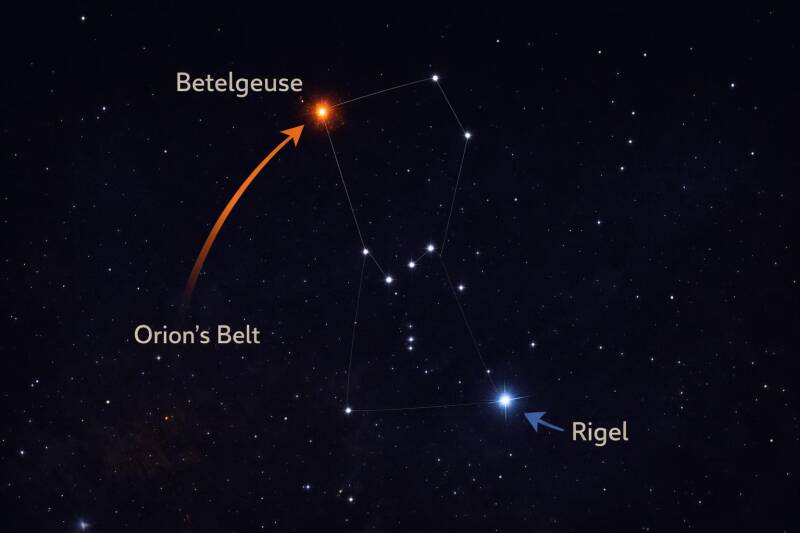
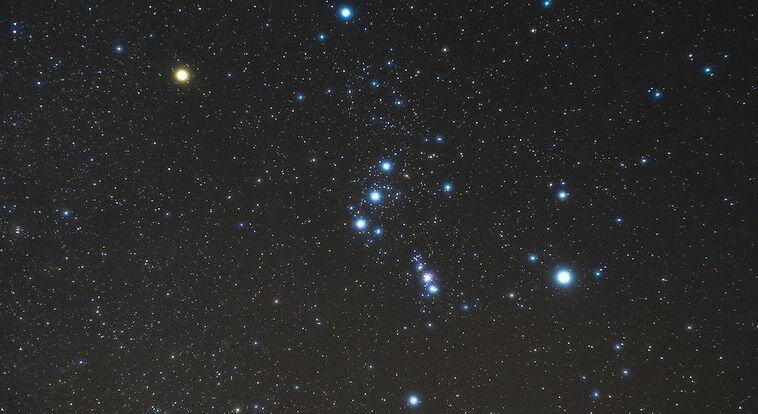
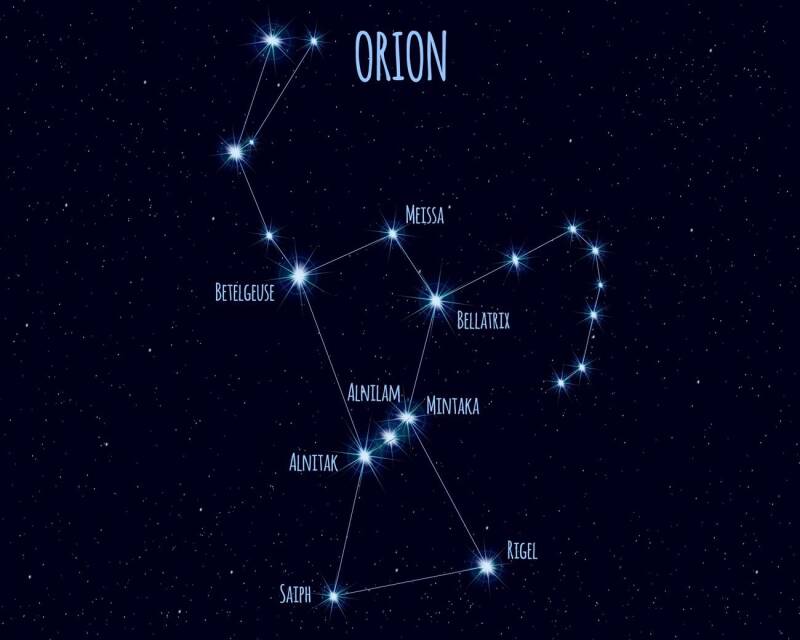
Anyone who has looked at the famous Orion constellation has probably seen Betelgeuse without realizing it.
Betelgeuse is the bright reddish-orange star located near the upper left corner of Orion. Its distinctive color makes it easy to identify, even in areas with light pollution.
But behind this familiar point of light is a truly enormous cosmic object.

A True Giant Among Stars
Betelgeuse belongs to a class of stars known as red supergiants.
These are some of the largest stars in the universe. They are massive stars that have reached the final stages of their evolution.
Compared with our Sun, Betelgeuse is almost unimaginable.
- The Sun has a diameter of about 1.39 million kilometers.
- Betelgeuse is hundreds of times larger.
- If Betelgeuse replaced our Sun, its outer layers could extend beyond the orbit of Mars and possibly approach Jupiter’s orbit.
That means Mercury, Venus, Earth, and Mars would all be located inside the star itself.
The scale of Betelgeuse is difficult to comprehend because it is completely different from anything found on Earth.
Why Is Betelgeuse Red?
Young massive stars are usually blue or white because they are extremely hot.
As stars age, their internal structure changes. When the hydrogen fuel in their core begins to run out, the star expands dramatically.
The outer layers become much larger and cooler, causing the star to appear red or orange.
Although Betelgeuse is still incredibly hot by human standards, with a surface temperature of around 3,500°C, it is much cooler than the Sun’s surface temperature of approximately 5,500°C.
That lower temperature creates the reddish appearance we see from Earth.
A Star That Is Constantly Changing
Unlike many stars that appear stable for thousands of years, Betelgeuse is constantly changing.
Astronomers classify it as a variable star, meaning its brightness naturally increases and decreases over time.
These changes happen because:
- the outer layers of the star expand and contract;
- enormous bubbles of hot gas move through the surface;
- powerful stellar winds release material into space.
Betelgeuse is not a quiet, stable star.
It is an enormous, active, and aging star approaching the final chapter of its existence.
The Mysterious Dimming of Betelgeuse in 2019
In late 2019, Betelgeuse captured worldwide attention.
The star suddenly became much dimmer than usual.
Astronomers and space enthusiasts immediately began asking:
“Is Betelgeuse about to explode?”
News organizations around the world reported on the possibility that humanity might soon witness a supernova.
However, further observations revealed a less dramatic but still fascinating explanation.
Betelgeuse had released a huge amount of material from its surface. As this material moved away from the star and cooled, it created a cloud of dust.
That dust temporarily blocked some of the light traveling toward Earth.
The star was not exploding.
Instead, astronomers were witnessing the violent and unpredictable behavior of a massive aging star.
Nevertheless, the event provided scientists with valuable information about how red supergiant stars lose mass before they die.
2. Why Are Scientists So Interested in Betelgeuse?
The universe contains billions of stars.
So why does Betelgeuse receive so much attention?
There are several important reasons.
Betelgeuse Is Relatively Close
In astronomical terms, Betelgeuse is located relatively nearby.
The star is estimated to be approximately 550 to 650 light-years away from Earth.
That sounds incredibly far away, but many stars studied by astronomers are thousands or millions of light-years distant.
Because Betelgeuse is relatively close, scientists can observe it in remarkable detail.
It is one of the few stars outside our solar system where astronomers have been able to study features on the surface itself.
A Rare Scientific Opportunity
Supernova explosions are among the most dramatic events in the universe, but they are also rare.
A supernova occurs only a few times per century in a galaxy like the Milky Way. Many explosions are hidden from view because they happen on the opposite side of the galaxy or behind thick clouds of cosmic dust.
A Betelgeuse supernova would be different.
Scientists around the world would immediately point telescopes toward it.
Space telescopes, neutrino detectors, and other astronomical instruments would collect data from the very beginning of the explosion.
Humanity has never had the technology to observe such a nearby supernova with today’s level of precision.
A Natural Laboratory for Astronomy
Betelgeuse allows scientists to investigate some of the biggest questions in astrophysics.
Researchers study the star to understand:
- how massive stars are born;
- how stars lose mass;
- why some stars become unstable;
- how elements are created inside stars;
- and what causes a star to collapse into a supernova.
Every observation of Betelgeuse helps improve our understanding of how the universe evolves.
The Star Factory of the Elements
One of the most fascinating facts about stars like Betelgeuse is that they create many of the elements needed for planets and life.
During their lives, massive stars produce heavier elements through nuclear fusion.
When they eventually explode, they spread these elements throughout space.
The oxygen we breathe, the iron in our blood, and many other elements found on Earth were created inside ancient stars that lived and died before our Solar System existed.
Betelgeuse is therefore not only a star that will end its life dramatically.
It is also part of the cosmic story that made our existence possible.


3. Why Will Betelgeuse Eventually Explode?
Every star has a life cycle. Stars are born, they evolve over millions or billions of years, and eventually they reach the end of their existence.
Small stars like our Sun end their lives relatively quietly. They slowly shed their outer layers and leave behind a dense core known as a white dwarf.
Massive stars like Betelgeuse have a very different fate.
Because they contain so much more mass, their lives are faster, more violent, and far more spectacular. Their final moment comes in the form of one of the most powerful events in the universe: a supernova explosion.
But why does Betelgeuse have to explode?
The answer lies deep inside its core.

The Fuel Inside a Star Slowly Runs Out
Stars shine because of a process called nuclear fusion.
Deep inside a star’s core, enormous pressure and extreme temperatures force atoms to combine. During this process, lighter elements are transformed into heavier ones, releasing tremendous amounts of energy.
Our Sun currently converts hydrogen into helium.
That energy creates the sunlight and heat that make life on Earth possible.
Betelgeuse, however, has already passed through many stages of this process.
Because it is much more massive than the Sun, it burns through its nuclear fuel at an extraordinary rate.
A massive star may live only millions of years, while smaller stars can survive for billions of years.
In cosmic terms, Betelgeuse has lived a short but incredibly intense life.
The Onion-Like Structure of an Aging Star
As a massive star ages, its internal structure becomes increasingly complex.
Astronomers often compare this structure to the layers of an onion.
Different layers contain different elements, created during different stages of nuclear fusion.
The process follows a sequence:
- Hydrogen becomes helium.
- Helium becomes carbon.
- Carbon becomes neon.
- Neon becomes oxygen.
- Oxygen becomes silicon.
- Silicon becomes iron.
Each stage requires higher temperatures and more extreme conditions.
Eventually, the core becomes dominated by iron.
This is the point where the star reaches a critical limit.
Why Iron Leads to a Supernova
Iron is unique among elements inside a massive star.
The fusion of lighter elements releases energy.
But trying to fuse iron into heavier elements requires energy instead of producing it.
This creates a catastrophic problem.
The star can no longer generate enough outward pressure to fight against its own enormous gravity.
For millions of years, two forces have been in balance:
- gravity pulling everything inward;
- energy from fusion pushing outward.
Once fusion can no longer support the core, gravity wins.
The collapse happens almost instantly.
The Core Collapse: The Beginning of the Explosion
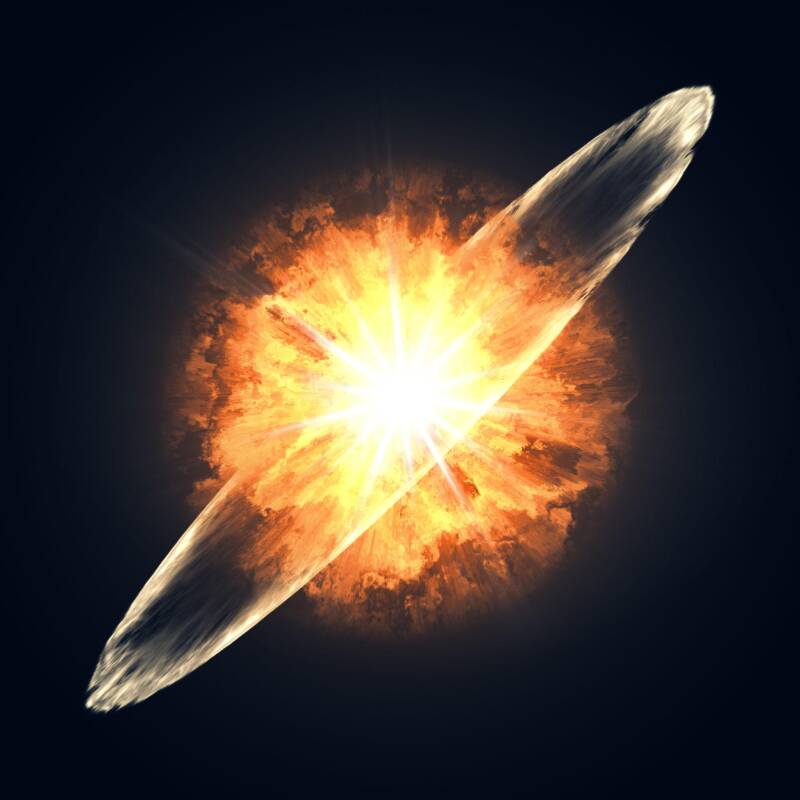
When Betelgeuse reaches the end of its life, its core will collapse in a matter of seconds.
The pressure becomes so extreme that electrons and protons combine to form neutrons.
The core becomes incredibly dense.
A huge shockwave forms and travels outward through the star.
When this shockwave reaches the outer layers, it throws the star’s material into space at enormous speeds.
This is the moment a supernova is born.
The explosion is so powerful that for a short period, the dying star can become brighter than billions of normal stars combined.
4. What Happens During a Supernova?
A supernova is not simply a large explosion.
It is a complex chain of physical processes involving gravity, nuclear reactions, radiation, and extreme temperatures.
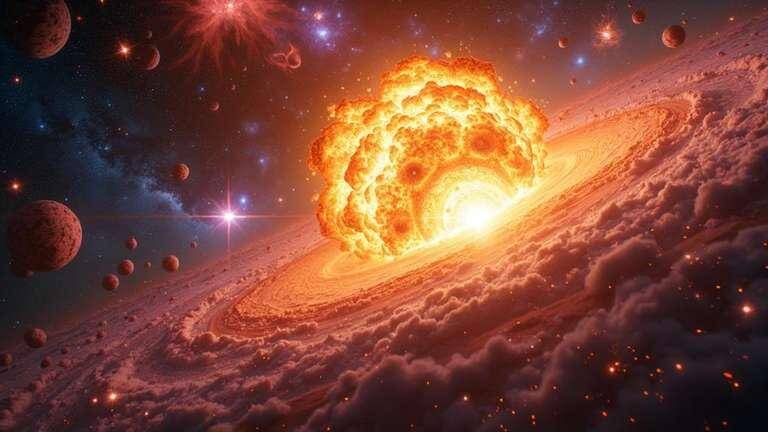
The explosion of Betelgeuse would release an unimaginable amount of energy.
In just a few seconds, the event could produce more energy than our Sun will generate during its entire lifetime.
That energy is released in several forms:
- visible light;
- ultraviolet radiation;
- X-rays;
- neutrinos;
- high-energy particles.
Each of these signals provides scientists with different information about what happened inside the star.
How Bright Will Betelgeuse Become?
One of the most exciting questions is:
What will Betelgeuse look like from Earth after it explodes?
The answer is extraordinary.
Betelgeuse is already one of the brightest stars visible from our planet.
During a supernova, its brightness would increase dramatically.
Astronomers expect that it could become one of the brightest objects in the night sky.
Some predictions suggest that it could appear as bright as a crescent Moon or even brighter than Venus, although the exact brightness is uncertain.
The result would be a breathtaking sight.
Could Betelgeuse Be Visible During the Day?
One of the most fascinating possibilities is that Betelgeuse could become visible in daylight.
Normally, stars disappear during the day because sunlight overwhelms their weak light.
A nearby supernova, however, is a completely different situation.
If Betelgeuse reaches the expected brightness level, people may be able to see it even when the Sun is above the horizon.
Imagine looking into the daytime sky and seeing a bright point of light that was not there before.
It would be an astronomical event unlike anything most humans have ever experienced.
How Long Would the Supernova Last?
Movies often show explosions happening instantly.
In reality, a supernova develops over a much longer period.
The initial collapse of the core happens in seconds, but the visible explosion continues for weeks or months.
The expected timeline would look something like this:
First moments:
The core collapses and releases enormous amounts of energy.
Shortly afterward:
Neutrinos escape from the core and travel through space.
Hours later:
The first visible light from the explosion reaches observers.
Following days:
The supernova becomes brighter and reaches its peak intensity.
Weeks to months:
The explosion slowly fades while the expanding debris continues moving outward.
Years later:
Astronomers continue studying the expanding cloud of material.
A Betelgeuse supernova would remain scientifically valuable for decades.
What Will Remain After Betelgeuse Explodes?
When a massive star explodes, the original star does not simply disappear.
The fate of the remaining core depends on its final mass.
There are two possible outcomes.
Scenario 1: A Neutron Star
The first possibility is the formation of a neutron star.
A neutron star is one of the strangest objects known in physics.
It is incredibly compact:
- It can contain more mass than the Sun.
- It may have a diameter of only around 20 kilometers.
- Its density is almost impossible to imagine.
A small amount of neutron star material would weigh billions of tons on Earth.
Some neutron stars also rotate extremely rapidly and produce powerful magnetic fields.
These objects are known as pulsars when they emit regular beams of radiation.
Scenario 2: A Black Hole
If the remaining core is massive enough, even neutron pressure may not stop the collapse.
The core could continue collapsing until it forms a black hole.
A black hole is an area of space where gravity becomes so strong that nothing, not even light, can escape.
However, this does not mean a black hole created by Betelgeuse would suddenly threaten Earth.
The distance between Earth and Betelgeuse is far too great.
A black hole does not act like a cosmic vacuum cleaner.
At a distance, its gravitational effect would be similar to the mass that existed before the collapse.
5. What Will Betelgeuse Look Like From Earth?
The most exciting part of the entire event is what humans will actually see.
For thousands of years, people have looked at Orion and recognized Betelgeuse as one of its defining stars.
One day, that familiar star may transform into something completely different.
A New Bright Object in the Sky
After the explosion, Betelgeuse would become dramatically brighter.
People around the world would notice something unusual in the Orion constellation.
A star that was once just a point of reddish light would become one of the most obvious objects in the sky.
It would likely attract attention from professional astronomers and casual observers alike.
A Brighter Night Sky
The supernova could temporarily change the appearance of the night sky.
The area around Orion would become much brighter, and Betelgeuse would dominate the region.
Under ideal conditions, the light from the explosion could even create faint shadows at night.
It would not be another Sun, but it could become one of the brightest astronomical events visible from Earth.

6. Is Earth in Danger When Betelgeuse Explodes?
The short answer is:
No.
Despite the dramatic nature of the explosion, Earth is safe.
This is one of the biggest misconceptions surrounding Betelgeuse.
The Distance Protects Earth
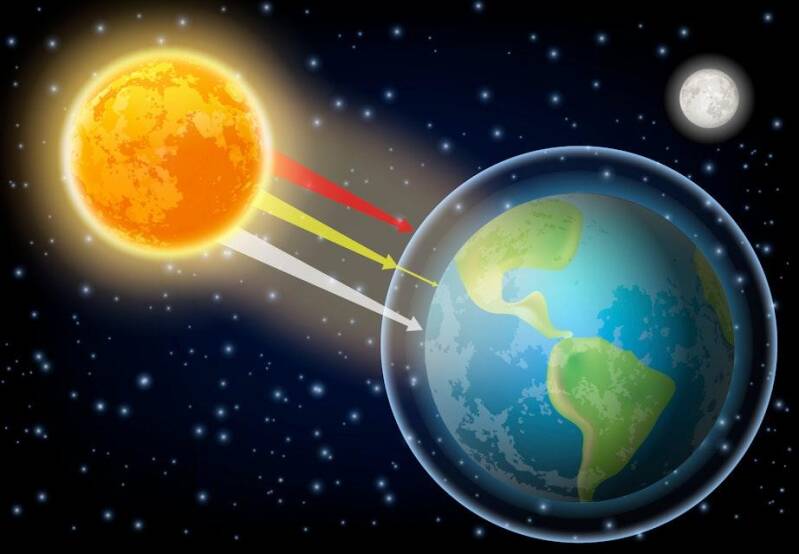
Betelgeuse is hundreds of light-years away.
That distance is enormous.
Although the explosion will release incredible amounts of energy, the intensity decreases rapidly as the radiation spreads through space.
A supernova would need to occur much closer to Earth to cause serious damage.
Scientists generally consider a distance of around 50–100 light-years or less to be a potential concern, depending on the type of explosion.
Betelgeuze is safely beyond that range.
Could Radiation From Betelgeuse Harm Us?
A supernova releases different forms of radiation.
Some people worry about dangerous gamma rays or cosmic particles reaching Earth.
However, Betelgeuse is not positioned in a way that would expose our planet to a dangerous beam of radiation.
In addition, its distance provides an enormous safety buffer.
The most noticeable effect for humans would simply be the spectacular view in the sky.
No Global Disaster, Just a Cosmic Spectacle
When Betelgeuse explodes, Earth will not experience:
- earthquakes;
- climate collapse;
- dangerous gravitational effects;
- destruction of the planet.
Instead, humanity will witness a rare natural phenomenon.
For scientists, it will be a priceless research opportunity.
For everyone else, it will be one of the most beautiful sights the universe can offer.

7. What Scientists Can Learn From the Explosion of Betelgeuse
A supernova explosion of Betelgeuse would not only be a spectacular event for people watching the night sky. For astronomers, it would represent one of the greatest scientific opportunities in modern history.
The reason is simple:
For the first time, humanity would be able to study a nearby supernova using today’s most advanced technology.
Scientists would observe the explosion across multiple wavelengths of light, detect invisible particles, and collect information about the final moments of a massive star.
Betelgeuse would become a natural laboratory for understanding how the universe works.
Understanding How Massive Stars Live and Die
Massive stars play a crucial role in the evolution of galaxies.
They create heavy elements, influence the formation of new stars, and shape the chemical composition of the universe.
By studying Betelgeuze before, during, and after its explosion, scientists could answer important questions such as:
- How do giant stars change during their final years?
- How do red supergiants lose mass?
- What triggers the collapse of a massive star?
- How are elements created and distributed throughout space?
- How are neutron stars and black holes formed?
A Betelgeuse supernova would provide answers that cannot be obtained from distant observations alone.
Neutrinos: The Invisible Messengers of a Supernova
One of the most fascinating aspects of a supernova is that the first information about the explosion does not come from light.
It comes from tiny particles called neutrinos.
Neutrinos are among the most mysterious particles in the universe.
They have almost no interaction with normal matter, meaning trillions of them pass through your body every second without you noticing.
During a supernova, an enormous number of neutrinos are produced inside the collapsing core of the star.
Why Are Neutrinos Important?
Light produced during the explosion takes time to escape from the star.
Neutrinos, however, can travel directly from the core into space.
This means they carry information from the exact moment when the star begins to collapse.
By detecting neutrinos from Betelgeuse, scientists could learn about:
- the structure of the collapsing core;
- the energy released during the explosion;
- the physics of matter under extreme pressure;
- the formation of neutron stars.
A nearby supernova would allow researchers to combine visible observations with particle physics in a way never achieved before.
A Supernova and the Creation of Elements
One of the most important roles of supernova explosions is the creation and distribution of elements.
The universe began mainly with hydrogen and helium.
Almost every heavier element was created later inside stars.
Massive stars like Betelgeuse act as cosmic factories.
During their lifetimes, they produce elements such as:
- carbon;
- oxygen;
- silicon;
- sulfur;
- calcium;
- iron.
When these stars explode, they spread these materials throughout space.
Eventually, this enriched material becomes part of new stars, planets, and possibly living organisms.
We Are Made From Ancient Stars
The famous phrase “we are made of stardust” is scientifically accurate.
The atoms in our bodies were created billions of years ago inside stars that existed before the Sun was born.
The iron in our blood, the calcium in our bones, and the oxygen we breathe all have a cosmic history.
A future Betelgeuse supernova would be another chapter in this endless cycle of creation and renewal.
How Likely Is It That Betelgeuse Will Explode Soon?
This is one of the most common questions about the star.
The honest answer is:
Scientists do not know the exact date.
Astronomers know that Betelgeuse is approaching the end of its life, but predicting the precise moment of a supernova is extremely difficult.
Could Betelgeuse Explode Tomorrow?
Technically, yes.
The light we see from Betelgeuse today left the star hundreds of years ago.
It is possible that the star has already exploded, but the light from that event has not reached Earth yet.
However, that does not mean an explosion is likely to happen tomorrow.
Could It Take Thousands of Years?
Yes.
A star’s final stages are difficult to predict.
Although Betelgeuse is considered close to the end of its life, “close” in astronomy can still mean thousands or even hundreds of thousands of years.
The important point is that the explosion will happen eventually.
The universe simply operates on a much longer timeline than human civilization.


8. Frequently Asked Questions About Betelgeuse
When will Betelgeuse explode?
Nobody knows the exact time when Betelgeuse will explode. Scientists know it is a massive aging star in the final stages of its evolution, but the explosion could happen anytime within a very wide range of possibilities.
What happens when Betelgeuse explodes?
When Betelgeuse explodes, its core will collapse and trigger a supernova. The outer layers of the star will be thrown into space, creating an extremely bright cosmic event visible from Earth.
Will Betelgeuse destroy Earth?
No. Betelgeuse is located hundreds of light-years away, which means the explosion will not destroy Earth or create a global catastrophe.
How bright will Betelgeuse become?
A Betelgeuse supernova could become one of the brightest objects in the night sky. It may rival the brightness of planets such as Venus and could possibly be visible during daylight.
Can humans see Betelgeuse during the day after it explodes?
It is possible. If the supernova reaches sufficient brightness, it may remain visible even when the Sun is above the horizon.
Will Betelgeuze become a black hole?
Possibly, but scientists believe a neutron star is more likely depending on the final mass of the remaining core. The exact outcome cannot be known until the explosion occurs.
Is Betelgeuse bigger than the Sun?
Yes. Betelgeuse is hundreds of times larger than the Sun and is classified as a red supergiant star.
Why is Betelgeuse important?
Betelgeuse is important because it allows scientists to study how massive stars evolve, lose mass, create elements, and eventually explode as supernovae.
Why Betelgeuse Remains One of the Most Fascinating Stars in the Universe
Betelgeuse is more than just a bright star in the Orion constellation.
It represents one of the most important processes in the universe: the life and death of stars.
When Betelgeuse eventually explodes, humanity will witness the final moments of a star that has existed for millions of years.
But the explosion will also represent a beginning.
The material released into space will eventually contribute to future generations of stars and planets.
The universe is constantly recycling matter.
Stars are born from the remains of previous stars, and those stars create the ingredients needed for future worlds.
Betelgeuse is part of this endless cosmic cycle.
9. Conclusion: What Happens When Betelgeuse Explodes?
The question “What Happens When Betelgeuse Explodes?” leads to one of the most fascinating stories in astronomy.
Betelgeuse is a massive red supergiant nearing the end of its life. Eventually, its core will collapse, creating a powerful supernova explosion that will transform the star forever.
From Earth, the event will likely appear as an incredibly bright object in the sky, visible for weeks or months.
Although the explosion sounds dangerous, our planet will be safe because Betelgeuse is located hundreds of light-years away.
For scientists, however, the event will be extraordinary.
A Betelgeuse supernova would provide an unprecedented opportunity to study:
- how massive stars die;
- how elements are created;
- how neutron stars form;
- and how the universe continues to evolve.
When Betelgeuse explodes, we will not simply witness the death of a star.
We will witness the continuation of the cosmic story that created planets, life, and ultimately ourselves.
The explosion of Betelgeuse will remind humanity of our connection to the universe.
We are not separate from the cosmos.
We are part of it.
Want to Learn More?
Are you fascinated by space exploration, astronomy, and the greatest mysteries of our universe?
Follow our blog for more in-depth articles about NASA, historic space missions, scientific discoveries, and the facts behind the most discussed stories from space.
Stay informed about the latest developments as well as the fascinating mysteries that the universe still has waiting for us.
Francois Hoogstrate
Founder & Editor of DeepSpaceJournal
Francois Hoogstrate researches and writes about astronomy, NASA missions, cosmology, planetary science, and space exploration. His articles focus on presenting complex scientific topics in a clear, balanced, and accessible way, using information from official space agencies, scientific publications, and historical sources.
Sources & References
- NASA Science – What is Betelgeuse? Inside the Strange, Volatile Star
https://science.nasa.gov/universe/what-is-betelgeuse-inside-the-strange-volatile-star/ - NASA Science – Supernovae
https://science.nasa.gov/universe/stars/supernovae/ - NASA Imagine the Universe! – Stars and Stellar Evolution
https://imagine.gsfc.nasa.gov/science/objects/stars1.html - NASA Imagine the Universe! – Supernovae
https://imagine.gsfc.nasa.gov/science/objects/supernovae1.html - NASA Hubble – Hubble Finds that Betelgeuse's Mysterious Dimming Is Due to a Traumatic Outburst
https://science.nasa.gov/missions/hubble/hubble-finds-that-betelgeuses-mysterious-dimming-is-due-to-a-traumatic-outburst/ - NASA Technical Reports Server (NTRS) – The Great Dimming of Betelgeuse
https://ntrs.nasa.gov/citations/20230001244 - European Space Agency (ESA) – Gaia Mission
https://www.esa.int/Science_Exploration/Space_Science/Gaia - European Southern Observatory (ESO) – Betelgeuse Observations
https://www.eso.org/public/search?adv=1&search=Betelgeuse - European Southern Observatory (ESO) – Betelgeuse's Great Dimming Event
https://www.eso.org/public/images/potw2343a/ - Super-Kamiokande Observatory – Official Website
https://www-sk.icrr.u-tokyo.ac.jp/en/ - IceCube Neutrino Observatory – Official Website
https://icecube.wisc.edu/ - Burbidge, E. M., Burbidge, G. R., Fowler, W. A., & Hoyle, F. (1957). Synthesis of the Elements in Stars (B²FH). Reviews of Modern Physics, 29(4), 547–650.
https://ui.adsabs.harvard.edu/abs/1957RvMP...29..547B - Dupree, A. K., et al. (2022). The Great Dimming of Betelgeuse: A Surface Mass Ejection and its Consequences.
https://arxiv.org/abs/2208.01676 - Gehrels, N., et al. (2003). Ozone Depletion from Nearby Supernovae. The Astrophysical Journal, 585, 1169–1176.
https://iopscience.iop.org/article/10.1086/376517 - Encyclopaedia Britannica – Betelgeuse
https://www.britannica.com/place/Betelgeuse
Add comment
Comments