

Written by Francois Hoogstrate
Last update: 11-08-2026

Introduction
The universe may look peaceful from Earth, but beyond our night sky lies a place of unimaginable violence. Giant stars explode with the energy of billions of suns, invisible radiation races across galaxies, gravity can tear planets apart, and black holes create regions where even light cannot escape.
These extreme cosmic environments are not just spectacular—they are essential to understanding how the universe works. By studying them, astronomers learn how stars are born, how galaxies evolve, where heavy elements like gold originate, and what the distant future holds for our own Solar System.
Fortunately, Earth is located in a relatively calm corner of the Milky Way. But elsewhere in the cosmos, there are places where no known form of life could survive, and where the laws of physics are pushed to their limits.
In this article, we'll explore some of the most dangerous places in the universe—from the giant star Betelgeuse and incredibly dense neutron stars to white dwarfs, gamma-ray bursts, and other extreme cosmic phenomena. Along the way, you'll discover why these objects are so dangerous, whether they could ever threaten Earth, and what they reveal about the remarkable universe we live in.
Quick Answers
- What is the most dangerous object in the universe? Black holes, neutron stars, and gamma-ray bursts are among the most dangerous cosmic phenomena.
- Could Betelgeuse destroy Earth? No. It is too far away to pose any threat to Earth.
- Are black holes a threat to Earth? No known black hole is close enough to affect our planet.
- What is the most realistic space threat to Earth? Asteroids remain the most realistic natural threat to our planet.
- Is Earth safe from these cosmic dangers? Yes. Earth is located in a relatively calm region of the Milky Way, protected by a stable Sun, a magnetic field, and a life-supporting atmosphere.
Key Takeaways
- The universe contains some of the most extreme environments known to science, including black holes, neutron stars, supernovas, white dwarfs, gamma-ray bursts, and asteroids.
- Black holes have gravity so powerful that once an object crosses the event horizon, not even light can escape, making them some of the most extreme objects in the known universe.
- Betelgeuse is approaching the end of its life and will eventually explode as a supernova, but it is too far away to pose any danger to Earth.
- Neutron stars are among the densest objects in the universe, with gravity strong enough to bend light and tear matter apart through tidal forces.
- White dwarfs are the remnants of Sun-like stars and can destroy nearby planets through their intense gravitational pull.
- Gamma-ray bursts are the most energetic explosions in the observable universe, capable of affecting planets across vast distances if their radiation is directed toward them.
- Asteroids remain the most realistic cosmic threat to Earth, which is why astronomers continuously monitor near-Earth objects.
- Studying these extreme cosmic phenomena helps scientists understand how stars evolve, where heavy elements like gold are formed, and what the future holds for our own Solar System.
- Despite these dangers, Earth is located in a relatively safe region of the Milky Way, protected by a stable Sun, a magnetic field, and a life-supporting atmosphere.
Table of Contents
- Betelgeuse: A Ticking Time Bomb
- Neutron Stars
- Black Holes
- White Dwarfs
- Gamma-Ray Bursts
- Asteroids
- Why Earth Is Still Safe
- Frequently Asked Questions
- Conclusion
1. Betelgeuse: A Ticking Time Bomb in Our Night Sky
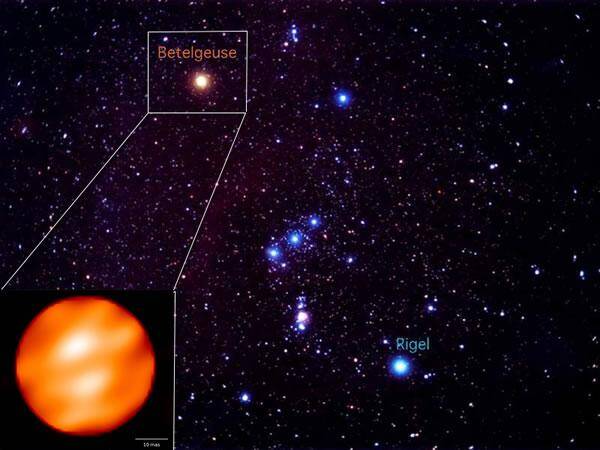
Every winter, the constellation Orion dominates the evening sky. One of its brightest and most recognizable stars is Betelgeuse. Its distinctive reddish glow makes it impossible to miss.
But beneath its beautiful appearance hides a true cosmic giant.
Located approximately 640 light-years from Earth, Betelgeuse is one of the largest stars ever discovered. If it were placed at the center of our Solar System, its outer layers would extend beyond the orbit of Jupiter. That makes it hundreds of millions of times larger than Earth and one of the most impressive red supergiants known to science.


Why Is Betelgeuse So Special?
Stars generate energy through nuclear fusion, converting hydrogen into helium deep within their cores. This process allows stars to shine for billions of years.
However, the larger a star becomes, the shorter its lifespan.
While our Sun is expected to live for roughly 10 billion years, Betelgeuse has consumed its nuclear fuel at a much faster rate. Astronomers believe this enormous red supergiant has entered the final chapter of its existence.
And that means one thing.
One day, it will explode.
No one knows exactly when.
It could happen tomorrow.
Or it could happen one hundred thousand years from now.
On a cosmic timescale, however, that's practically any moment now.
The Incredible Power of a Supernova
When a massive star like Betelgeuse reaches the end of its life, it doesn't simply fade away.
Instead, it dies in one of the most violent events in the universe: a supernova.
A supernova occurs when the core of a massive star collapses under its own gravity. Within a fraction of a second, a stable star transforms into an explosion so bright that it can temporarily outshine an entire galaxy.
The amount of energy released is almost impossible to comprehend.
Our Sun produces an enormous amount of energy every second. A single supernova releases approximately the same amount of energy that the Sun will generate throughout its entire 10-billion-year lifetime.
The explosion sends vast amounts of heat, light, radiation, plasma, and powerful shockwaves racing through space at thousands of kilometers per second. Everything nearby is exposed to unimaginable destructive forces. Planets, moons, asteroids, and potentially even entire planetary systems can be devastated.

Could Betelgeuse Threaten Earth?
Fortunately, the answer is no.
Although Betelgeuse is relatively close by astronomical standards, it is still more than 600 light-years away, far enough to pose no direct danger to Earth.
In fact, when Betelgeuse finally explodes, it will likely become one of the greatest astronomical spectacles ever witnessed by humanity.
For several weeks, the supernova could shine almost as brightly as the full Moon. It may even be visible during daylight hours.
For astronomers and stargazers alike, it will be a once-in-a-lifetime event.
The Battle Every Star Eventually Loses
To understand why stars explode, we first need to understand how they survive for billions of years.
Every star exists because two enormous forces constantly compete with one another.
Gravity continuously tries to compress the star inward.
At the same time, nuclear fusion produces immense outward pressure by releasing vast amounts of energy.
As long as these opposing forces remain in perfect balance, the star remains stable.
But that balance cannot last forever.
When a Star Runs Out of Fuel
Inside massive stars, hydrogen first fuses into helium. As the star ages, it begins creating progressively heavier elements, including carbon, neon, oxygen, and silicon.
Eventually, the star starts producing iron.
This is the point where everything changes.
Unlike previous fusion reactions, fusing iron does not release energy. Instead, it consumes energy.
Without an energy source capable of resisting gravity, the star can no longer support itself.
Gravity wins.
In less than a second, the core collapses. The outer layers rush inward before rebounding outward in an unimaginably powerful explosion—the supernova. Although astronomers understand the overall process remarkably well, many of its finer details remain one of modern astrophysics' greatest mysteries.


From Star to Cosmic Monster
A supernova is not always the end.
Often, it marks the beginning of something even more extraordinary.
After the explosion, the collapsed core remains behind. Depending on the original mass of the star, it may become one of three extraordinary objects:
- A white dwarf
- A neutron star
- A black hole
Among these, neutron stars rank among the most dangerous objects in the universe.
Their density is almost beyond imagination. A piece of neutron star material no larger than a sugar cube would weigh more than an entire mountain on Earth. These incredible remnants are formed from the collapsed cores of massive stars and are second only to black holes in terms of density.
And that brings us to perhaps the strangest object of them all.
A star no larger than a city...
Yet containing more mass than our Sun.
More Betelgeuse News? ----> Click Here!
2. Neutron Stars: Among the Most Dangerous Objects in the Universe
After a supernova explosion, it may seem like the cosmic spectacle has come to an end. In reality, this is where one of the most fascinating and extreme chapters in astronomy begins.
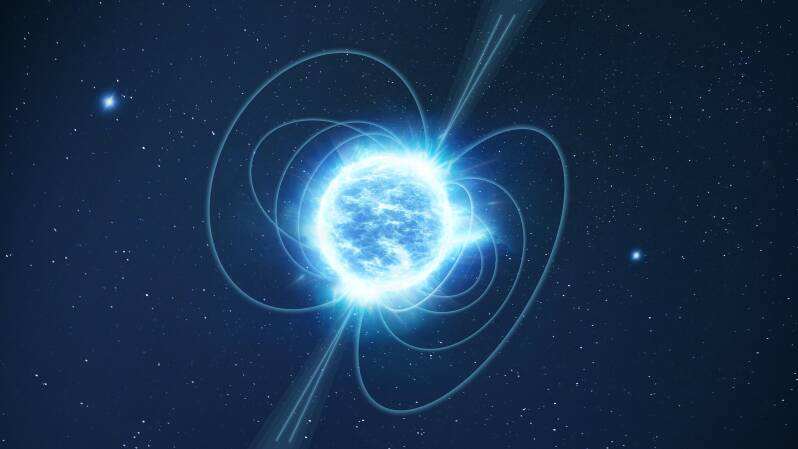
A neutron star is the incredibly dense collapsed core of a massive star left behind after a supernova. Although it is only about the size of a city, it can contain more mass than our Sun. These extraordinary objects are among the densest and most dangerous objects in the universe, surpassed only by black holes in their extreme nature.
When a massive star reaches the end of its life, its core collapses under an unimaginable gravitational force. The atoms inside are compressed so tightly that almost all empty space between particles disappears. What remains is a strange cosmic object made mostly of tightly packed neutrons.
The result is one of the most extreme environments known to science.

What Makes Neutron Stars So Dangerous?
Neutron stars combine several of the most powerful forces in the universe:
- Extreme density
- Massive gravitational fields
- Intense radiation
- Powerful magnetic fields
- High-energy particle emissions
These conditions make neutron stars some of the most dangerous places in space, where normal physics behaves in ways that are almost impossible to imagine.
How Small Is a Neutron Star?
Despite containing roughly the same amount of mass as the Sun, a neutron star has a diameter of only around 20 kilometers (12 miles).
To understand just how extreme this is:
- An entire star is compressed into the size of a medium-sized city.
- A teaspoon of neutron star material would weigh billions of tons.
- Gravity on the surface would be hundreds of billions of times stronger than Earth's.
At this scale, matter itself is transformed into something completely different from anything found on our planet.
Can a Neutron Star Bend Light?
Yes.
The gravity of a neutron star is so powerful that it can actually bend the path of light. This phenomenon is known as gravitational lensing.
On Earth, gravity simply keeps objects from floating away. Near a neutron star, gravity affects the fabric of space itself.
Light traveling near the star is forced to follow curved paths, creating strange visual effects predicted by Einstein's theory of general relativity. An observer close enough to a neutron star would see a distorted view of the universe, with light appearing to wrap around the object.
What Would Happen If a Human Approached a Neutron Star?
Scientists often use thought experiments to explain just how dangerous neutron stars are.
Imagine an astronaut traveling toward one of these objects.
At first, everything appears normal.
But as the astronaut gets closer, the difference in gravitational force between their feet and their head becomes enormous.
This effect is called a tidal force.
And it would be fatal.
Spaghettification: When Gravity Tears Matter Apart
The process is often called spaghettification, a term used by astronomers to describe how extreme gravity stretches objects.
Movies often show a person slowly being stretched into a long, thin shape.
The reality would be far more violent.
The human body would not simply become longer.
It would be ripped apart by gravitational forces.
First, joints would separate.
Then muscles would tear.
Bones would fracture.
Organs would be pulled apart.
Within a fraction of a second, the body would be reduced into a stream of individual atoms falling toward the neutron star's surface.
There is no known way for any human-made object or living organism to survive such an encounter.
Could a Neutron Star Destroy Earth?
Fortunately, no known neutron star poses a threat to Earth.
Although these objects are incredibly dangerous, they are located extremely far away from our planet. The closest known neutron stars are not close enough to affect Earth in any meaningful way.
However, if a neutron star were located only a few hundred kilometers away, its gravitational influence would completely overwhelm our planet.
When Neutron Stars Collide: The Most Powerful Cosmic Events
A single neutron star is already one of the most extreme objects in the universe.
But sometimes two neutron stars exist in the same system.
Over millions of years, these objects orbit each other while losing energy through gravitational waves. Their orbit gradually shrinks until they eventually collide.
These collisions are among the most energetic events ever detected.
During these violent cosmic mergers, enormous amounts of energy are released and heavy elements such as:
- Gold
- Platinum
- Uranium
are created.
In fact, much of the gold found on Earth may have been formed billions of years ago during ancient neutron star collisions.
Every piece of gold jewelry carries a story that began in one of the most powerful explosions in the universe.
Stars That Disappear Without Exploding
Not every massive star ends its life with a spectacular supernova.
Some stars appear to simply vanish.
Astronomers refer to this mysterious possibility as an unnova.
What Is an Unnova?
Normally, scientists expect a massive star to explode before collapsing into a neutron star or black hole.
However, some extremely massive red supergiants may collapse directly into a black hole.
The process happens so quickly that almost no visible light escapes.
From Earth, it would appear as though the star had suddenly disappeared from the night sky.
No explosion.
No warning.
Just darkness.
Why Would a Missing Star Be Dangerous?
Imagine a planet orbiting such a star.
One evening, its sun shines normally.
The next moment...
it is gone.
The planet has lost its source of energy forever.
Without sunlight, temperatures would begin falling rapidly.
Over time:
- Oceans would freeze.
- The atmosphere would begin collapsing.
- The planet would become a frozen and lifeless world.
A vanished star may seem less dramatic than a supernova, but for any nearby planet, the consequences would be equally devastating.
Vampire Stars: The Cosmic Objects That Steal Youth
Not all stars age in the same way.
Some appear to cheat death by stealing material from nearby stars.
Astronomers discovered this strange phenomenon while studying ancient star clusters. Among old red stars, they found unexpectedly young-looking blue stars.
These stars became known as Blue Stragglers.
How Do Vampire Stars Stay Young?
Many stars exist in binary systems.
When one star grows older and expands, its companion can begin pulling hydrogen-rich material away through gravity.
The receiving star gains fresh fuel for nuclear fusion.
As a result, it becomes brighter, hotter, and appears much younger than it actually is.
These cosmic "vampires" are not consuming blood—they are stealing stellar material.
Betelgeuse: The Cosmic Countdown Continues
Although Betelgeuse still shines brightly in our night sky, astronomers know that this massive red supergiant is approaching the final stage of its life.
The star has already consumed most of its hydrogen fuel.
Inside its core, heavier and heavier elements continue forming.
Each stage happens faster than the previous one:
- Hydrogen burns for billions of years.
- Helium burns for millions of years.
- Carbon lasts thousands of years.
- Neon lasts about one year.
- Silicon burns for only a few days.
Eventually, the core produces iron.
At that point, the star can no longer generate enough energy to resist gravity.
The collapse becomes inevitable.
Within seconds, the core will collapse and trigger a supernova explosion—one of the most powerful events in the universe.
More Neutron Stars News? ----> Click Here!
Frequently Asked Questions About Neutron Stars
What is the most dangerous object in the universe?
Black holes are often considered the most dangerous objects in the universe because their gravity can trap even light. However, neutron stars are among the densest and most extreme objects known.
How big is a neutron star?
A typical neutron star is only around 20 kilometers wide but can contain more mass than the Sun.
Can a neutron star destroy Earth?
A nearby neutron star could have catastrophic effects, but all known neutron stars are far enough away that Earth is safe.
Why are neutron stars so dense?
When a massive star collapses, gravity compresses its core so intensely that atoms are crushed together, creating matter composed mainly of neutrons.
Are neutron stars stronger than black holes?
Black holes are more extreme because they create regions where even light cannot escape. However, neutron stars are among the strongest and densest objects visible in the universe.
3. Black Holes: Where Even Light Cannot Escape
Among all the extreme objects in the universe, few are as mysterious and terrifying as black holes.
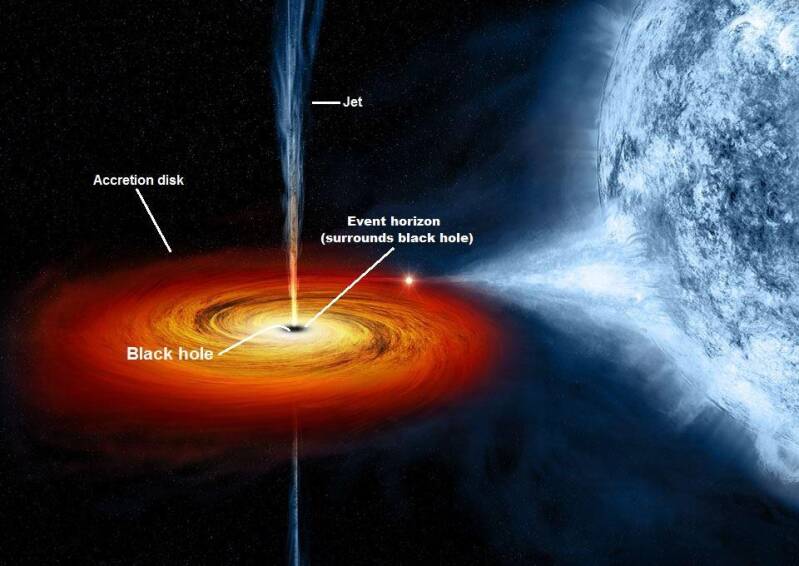
Unlike exploding stars or glowing galaxies, black holes cannot be seen directly. They produce no visible light of their own. Instead, they reveal their presence through their enormous gravitational influence on everything around them.
A black hole is a region of space where gravity becomes so powerful that nothing—not even light—can escape once it crosses a certain boundary.
This makes black holes some of the most dangerous and fascinating places in the universe.

How Are Black Holes Created?
Most black holes are born from the violent deaths of massive stars.
When a star much larger than our Sun reaches the end of its life, it can no longer produce enough energy through nuclear fusion to resist its own gravity. The star's core collapses inward, compressing an enormous amount of mass into an incredibly small region.
If the remaining core is massive enough, the collapse continues until a black hole forms.
The result is an object with gravity so extreme that it changes the structure of space and time itself.
However, not all black holes are created in the same way.
Astronomers have identified several types:
- Stellar black holes – formed from the collapse of massive stars and typically containing several times the mass of our Sun.
- Intermediate black holes – larger than stellar black holes but much smaller than the giants found in the centers of galaxies.
- Supermassive black holes – enormous black holes containing millions or even billions of times the mass of the Sun.
At the center of almost every large galaxy lies a supermassive black hole. Our own Milky Way galaxy is no exception.
Its central black hole is called Sagittarius A* and contains the mass of approximately four million Suns.
The Event Horizon: The Point of No Return
The most famous feature of a black hole is the event horizon.
This is the invisible boundary surrounding a black hole where escape becomes impossible.
Before crossing the event horizon, an object could theoretically escape if it moved fast enough.
After crossing it, escape is impossible.
Not because the object is being pulled by a normal force, but because the geometry of space itself has changed. Every possible path forward leads deeper into the black hole.
Even light, the fastest thing in the universe, cannot overcome this effect.
That is why black holes appear completely dark.
What Happens If Something Gets Too Close?
A black hole does not simply "suck" everything around it like a cosmic vacuum cleaner.
Objects can orbit black holes safely if they remain at a sufficient distance.
The danger begins when an object approaches too closely.
Near a black hole, the difference in gravitational force between one side of an object and the other can become enormous.
The result is a process known as spaghettification.
The stronger gravity on the closer side stretches the object while the weaker gravity on the opposite side pulls less strongly. Eventually, the object is stretched into a long stream of matter.
For a human approaching a black hole, the experience would be fatal. The body would be stretched apart at the atomic level before reaching the deepest regions of the black hole.
The Singularity: Where Physics Breaks Down
At the center of a classical black hole lies a region called the singularity.
According to Einstein's theory of general relativity, this is where matter is compressed into an infinitely small point with unimaginable density.
However, scientists believe this description is incomplete.
At such extreme conditions, the laws of general relativity and quantum physics no longer work together. Understanding what truly happens inside a black hole remains one of the greatest unanswered questions in modern physics.
Could a Black Hole Destroy Earth?
Fortunately, no known black hole poses any danger to Earth.
The closest known black holes are thousands of light-years away, far beyond any region where their gravity could affect our planet.
Even Sagittarius A*, despite its enormous size, is located approximately 26,000 light-years from Earth.
If our Sun were suddenly replaced by a black hole with exactly the same mass, Earth would not be pulled into it. Our planet would continue orbiting in almost the same way.
The difference would be that the Sun would no longer provide light and heat, leaving Earth frozen and lifeless.
Why Black Holes Matter to Science
Although black holes are among the most dangerous objects in the universe, they are also among the most important.
They help scientists understand:
- How galaxies form and evolve
- How gravity affects space and time
- How massive stars end their lives
- How the universe changes over billions of years
In recent years, observations of black holes have transformed astronomy. The first image of a black hole's shadow, captured by the Event Horizon Telescope in 2019, provided humanity with the first direct visual evidence of these mysterious objects.
Black holes remind us that the universe is far stranger and more extreme than anything we experience on Earth.
They are places where gravity reaches its ultimate limit—where space, time, and matter are pushed beyond anything humans can easily imagine.
More Black Holes News? ----> Click Here!
4. White Dwarfs: The Final Stage of Sun-Like Stars
When people imagine the death of a star, they often picture a spectacular explosion powerful enough to light up the universe. That dramatic ending is true for the most massive stars, but stars like our Sun follow a very different path.
A white dwarf is the incredibly dense stellar core left behind after a Sun-like star runs out of fuel and sheds its outer layers. Although it is roughly the size of Earth, it can contain about half the mass of the original star, making it one of the densest objects created by stellar evolution.
Unlike supernovas or black holes, white dwarfs do not end their lives in a violent explosion. Their destruction is quieter—but the process that creates them can completely transform an entire planetary system.
These remnants represent one of the most fascinating stages in the life cycle of stars and provide astronomers with a glimpse into the distant future of our own Sun.

What Is a White Dwarf?
A white dwarf is the final evolutionary stage of a medium-sized star, such as the Sun.
When these stars exhaust the hydrogen fuel in their cores, they expand into red giants before eventually losing their outer layers. The remaining core becomes a white dwarf—a small but incredibly dense object composed mainly of carbon and oxygen.
Although white dwarfs no longer produce energy through normal nuclear fusion, they continue to release stored heat and slowly cool over billions of years.
The Life of a Sun-Like Star
Like all stars, the Sun produces energy through nuclear fusion, converting hydrogen into helium deep inside its core.
This process has kept our star stable for approximately 4.5 billion years.
Astronomers estimate that the Sun still has around 5 to 6 billion years before it begins the dramatic changes that will eventually end its life as a normal star.
That may seem like an unimaginable amount of time.
But on a cosmic scale, even the lifespan of a star is temporary.
When the Sun Becomes a Red Giant
Eventually, the hydrogen fuel inside the Sun's core will begin to run out.
When this happens, the balance between gravity and nuclear fusion will be disrupted.
The core will contract.
The outer layers will expand dramatically.
Our calm yellow star will transform into a massive red giant.
And this transformation will be catastrophic for the inner Solar System.
Mercury and Venus are expected to be completely consumed by the expanding Sun.
Earth will also become uninhabitable.
Long before our planet is physically destroyed, temperatures will rise so dramatically that the oceans will evaporate and the atmosphere will begin to disappear.
The Earth we know today will become a completely different world.
What Will Happen to Earth When the Sun Dies?
As the Sun expands into a red giant, Earth will experience a series of devastating changes.
First, global temperatures will rise beyond the limits required for life.
Then the oceans will begin evaporating.
The increasing amount of water vapor in the atmosphere will strengthen the greenhouse effect, causing temperatures to rise even faster.
Eventually, Earth will lose:
- Oceans
- Rivers
- Lakes
- Vegetation
- Almost all known forms of life
Even if Earth avoids being swallowed by the expanding Sun, it will become a dry, overheated planet—a lifeless world orbiting a dying star.
The Birth of a White Dwarf
After the red giant phase ends, the Sun will shed its outer layers into space.
These glowing layers form a planetary nebula.
At the center remains only the exposed stellar core: a white dwarf.
Although a white dwarf is approximately the size of Earth, it still contains around half the mass of the original star.
This extreme compression makes white dwarfs some of the densest objects in the universe.
They no longer create significant energy through nuclear fusion.
Instead, they slowly cool and fade over billions of years.
White Dwarfs: Cosmic Graveyards of Destroyed Planets
Although white dwarfs are not as destructive as black holes or neutron stars, they can still create some of the most dangerous environments produced by dying stars.
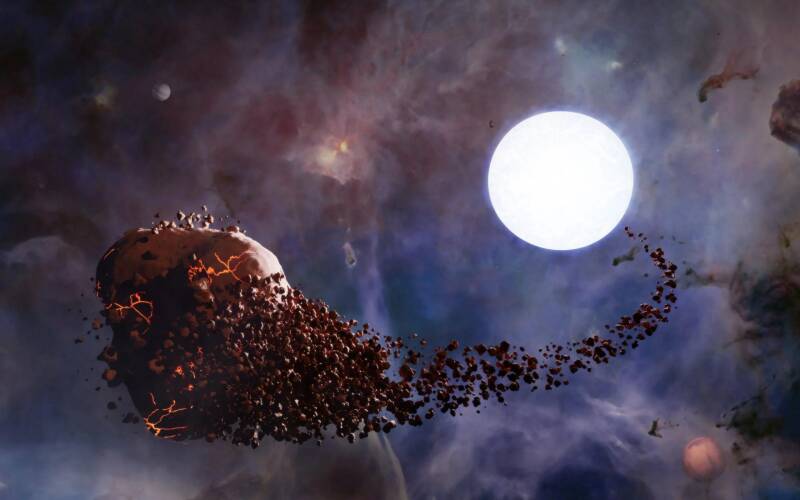
Astronomers have discovered several white dwarfs surrounded by the remains of destroyed planetary systems.
One of the most fascinating examples is SDSS J1228.
Researchers discovered a white dwarf surrounded by a disk of debris containing dust, rock, and heavy metals—the remains of a former planetary system.
Among this material may even be the iron core of a destroyed planet.
The planet was not simply damaged.
It was completely torn apart by the intense gravity of the white dwarf.
How Can a White Dwarf Destroy a Planet?
Although white dwarfs are much smaller than normal stars, their gravity is incredibly powerful.
When a planet passes too close, the difference in gravitational force between the side facing the white dwarf and the opposite side becomes extreme.
This creates powerful tidal forces.
The planet begins to stretch apart.
Eventually, it is completely destroyed.
The remaining material forms a ring of dust, rock, and metal that slowly spirals into the white dwarf.
This process gives astronomers a rare opportunity to study the remains of alien planets that no longer exist.
A Glimpse Into Earth's Future
Systems like SDSS J1228 are especially important because they offer a possible preview of the distant future of our own Solar System.
In several billion years, the Sun will also become a white dwarf.
So what will happen to Earth?
The planet will likely no longer resemble the world we know today.
Instead, it may become little more than a barren metallic core, slowly being destroyed by the gravity of the dead Sun.
Why Do Larger Stars Die Faster?
It may seem logical that larger stars should live longer because they contain more fuel.
The opposite is true.
The more massive a star becomes, the faster it consumes its fuel.
This happens because enormous gravitational pressure inside massive stars creates much higher temperatures, causing nuclear reactions to occur far more quickly.
Some giant stars survive for only a few million years.
The Sun, by comparison, will live for roughly ten billion years.
The Death of a Massive Star
During the final stages of a massive star's life, everything accelerates dramatically.
While hydrogen fusion can continue for billions of years, the final stages happen much faster:
- Helium: approximately one million years
- Carbon: approximately one thousand years
- Neon: about one year
- Silicon: about one day
Eventually, the star forms an iron core.
At that moment, the process stops.
Iron fusion cannot produce energy.
The star can no longer resist gravity.
The collapse becomes unavoidable.
Within less than a second, the core collapses completely, triggering the supernova explosion discussed earlier in this article.
Frequently Asked Questions About White Dwarfs
Will the Sun Become a White Dwarf?
Yes. After expanding into a red giant and losing its outer layers, the Sun will leave behind a white dwarf roughly the size of Earth.
Can a White Dwarf Explode?
Yes. Under certain conditions, a white dwarf can explode as a Type Ia supernova if it gains too much mass from a nearby companion star.
How Hot Is a White Dwarf?
Newly formed white dwarfs can reach temperatures above 100,000 degrees Celsius. Over billions of years, they slowly cool and become darker.
Are White Dwarfs Dangerous?
White dwarfs are not dangerous from a safe distance. However, their extreme gravity can destroy nearby planets and tear apart objects that come too close.
What Is the Difference Between a White Dwarf and a Black Hole?
A white dwarf is the dense leftover core of a Sun-like star. A black hole forms when a much more massive star collapses, creating gravity so strong that even light cannot escape.
The Next Cosmic Threat: Gamma-Ray Bursts
White dwarfs, supernovas, and neutron stars are among the most extreme phenomena in the universe.
But there is another cosmic event that surpasses even these powerful forces.
An explosion that releases more energy in seconds than the Sun will produce throughout its entire lifetime.
A phenomenon powerful enough to strip away the atmosphere of an entire planet.
This event is known as a Gamma-Ray Burst (GRB).
Many astronomers consider gamma-ray bursts to be among the most powerful explosions in the observable universe—and possibly one of the greatest cosmic dangers of all.
More White Dwarf News? ----> Click Here!
5. Gamma-Ray Bursts: The Most Powerful Explosions in the Universe
If supernovas already represent some of the most spectacular events in the cosmos, then Gamma-Ray Bursts (GRBs) take cosmic destruction to an entirely different level.
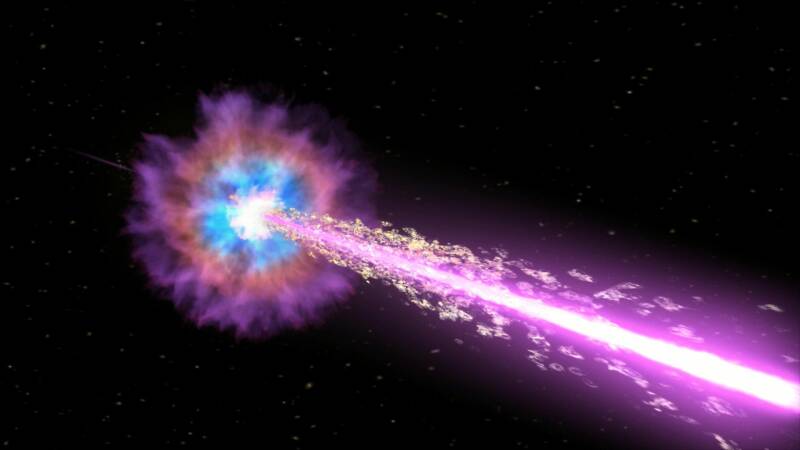
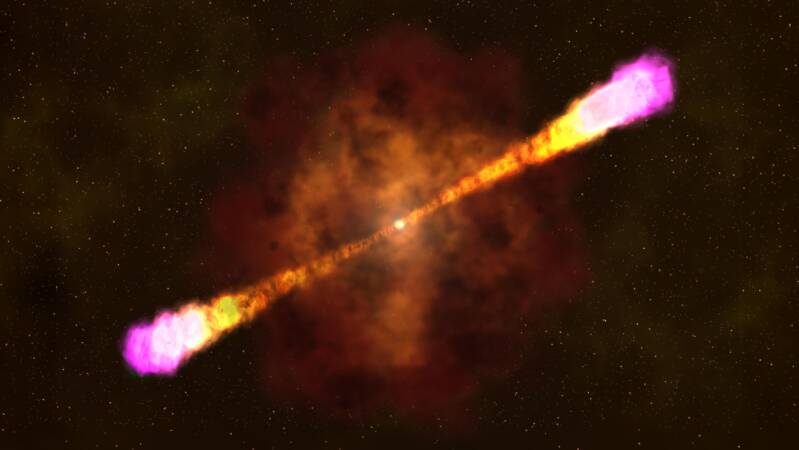
A Gamma-Ray Burst is an extremely powerful explosion that releases enormous amounts of high-energy radiation in a very short period of time. Many astronomers consider GRBs to be among the most energetic events in the observable universe—possibly the most powerful explosions since the Big Bang.
Within only a few seconds, a gamma-ray burst can release as much energy as our Sun will produce during its entire estimated lifetime of around 10 billion years.
These events are among the most dangerous phenomena in space, capable of affecting planets across vast cosmic distances.
How Does a Gamma-Ray Burst Form?
Most gamma-ray bursts occur when an extremely massive star reaches the end of its life.
These stars are often related to a rare class of stars known as Wolf-Rayet stars.
They are characterized by:
- Tens of times the mass of our Sun
- Extremely high surface temperatures
- Powerful stellar winds
- Extremely rapid rotation
When one of these massive stars collapses, it often creates a newly formed black hole.
During the collapse, enormous amounts of material are accelerated along the star's rotational axis at speeds approaching the speed of light.
This creates two narrow beams of gamma radiation.
These beams behave like a cosmic laser.
Anything located directly in the path of such a beam would be exposed to an unimaginable amount of energy.
Could a Gamma-Ray Burst Destroy Earth?
Fortunately, the answer is most likely no.
The chances of a dangerous gamma-ray burst directly hitting Earth are extremely small.
However, scientists have studied what could happen if a powerful GRB were aimed directly at our planet.
The first victim would not be humanity.
It would be Earth's atmosphere.
How a Gamma-Ray Burst Could Destroy the Ozone Layer
Gamma radiation would trigger chemical reactions high in Earth's atmosphere.
These reactions would create large amounts of nitrogen oxides, chemical compounds capable of destroying the protective ozone layer.
Without sufficient ozone, much more harmful ultraviolet radiation from the Sun would reach Earth's surface.
The consequences could include:
- Massive damage to plant life
- Disruption of food chains
- Severe effects on animals
- Extreme stress on almost every ecosystem on Earth
The destruction would not necessarily happen instantly.
Instead, it could trigger a chain reaction that gradually transforms the planet's environment.
Acid Rain and a Possible Global Ice Age
The effects of a gamma-ray burst would not stop with ozone depletion.
The nitrogen compounds created in the atmosphere could eventually return to Earth's surface as acid rain.
This could damage:
- Forest ecosystems
- Agricultural systems
- Ocean environments
At the same time, changes in the atmosphere could reduce the amount of sunlight reaching the surface.
This would cause global temperatures to drop.
Some scientists believe that a nearby gamma-ray burst could potentially trigger a period of severe global cooling or even contribute to a mass extinction event.
Fortunately, current observations indicate that the known Wolf-Rayet stars capable of producing these events are not aimed toward Earth.
More Gamma-Ray's News? ---->Click Here!
6. Asteroids: A More Realistic Cosmic Threat
Not every danger in the universe comes from exploding stars.
Sometimes, the greatest threats come from much smaller objects.
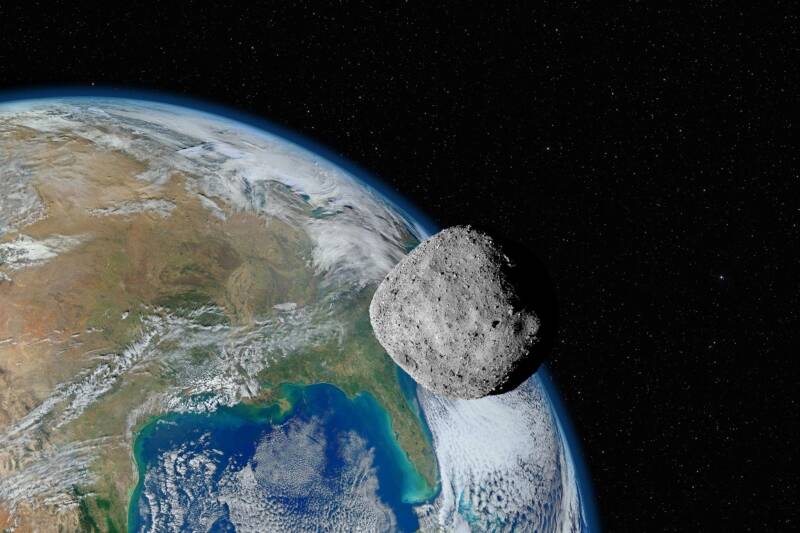
Asteroids have been among the most significant natural risks to planets for billions of years.
The most famous example occurred approximately 66 million years ago, when an asteroid impact likely contributed to the extinction of the dinosaurs.

Not All Asteroids Are the Same
Scientists classify asteroids into several major categories.
1. Rocky Asteroids
These are primarily made of stone and silicate materials.
They represent the most common type of asteroid.
2. Metallic Asteroids
These objects contain large amounts of iron and nickel.
Because of their greater density, they can create much more powerful impacts than rocky asteroids of the same size.
3. Rubble-Pile Asteroids
Unlike solid objects, rubble-pile asteroids consist of many smaller pieces held together loosely by gravity.
When they enter a planet's atmosphere, they may break apart into multiple fragments, creating a different type of impact scenario.
Why Do Astronomers Study Asteroids?
Understanding asteroids is essential for protecting Earth.
Using radar observations and space missions, scientists can estimate:
- Their size
- Their shape
- Their density
- Their composition
- Their future trajectories
This information allows researchers to identify potentially dangerous objects long before they could become a threat.
Why the Universe Is Still a Safe Place
After exploring exploding stars, neutron stars, black holes, and gamma-ray bursts, it may seem as though the universe is one giant cosmic danger zone.
But that is only part of the story.
The universe is also remarkably suitable for life.
Earth exists in an incredibly rare balance.
Our planet is located at the right distance from the Sun.
Our star is relatively stable.
Earth also benefits from:
- A protective atmosphere
- A strong magnetic field
- Liquid water
- A stable orbit around the Sun
These conditions make our planet extraordinarily special.
What Can Cosmic Dangers Teach Us?
Studying extreme cosmic events is not only about discovering spectacular phenomena.
It helps scientists answer some of the biggest questions in astronomy:
- How do stars form and evolve?
- How are planets created?
- Where do heavy elements like gold come from?
- How does our galaxy change over time?
- What will ultimately happen to our Sun?
Every discovery brings us closer to understanding our place in the universe.
Frequently Asked Questions About the Most Dangerous Phenomena in the Universe
What Is the Most Dangerous Place in the Universe?
There is no single answer. However, black holes, neutron stars, and gamma-ray bursts are among the most extreme and dangerous phenomena known to science.
Could Betelgeuse Destroy Earth?
No. Betelgeuse is located approximately 640 light-years away. When it eventually explodes as a supernova, it will likely become an incredible astronomical event, but it will not threaten Earth.
What Would Happen If You Approached a Neutron Star?
The extreme gravity of a neutron star would stretch and tear apart any object approaching it through a process known as tidal disruption or spaghettification.
Will Our Sun Ever Explode?
No. The Sun is not massive enough to become a supernova. Instead, it will expand into a red giant and eventually become a white dwarf.
How Likely Is a Gamma-Ray Burst to Hit Earth?
The probability is extremely low. The known massive stars capable of producing dangerous gamma-ray bursts are not currently aimed toward Earth.
Conclusion: The Universe Is Both Dangerous and Extraordinary
The universe is a place of unimaginable extremes.
Among peaceful galaxies and potentially habitable planets exist objects that push the laws of physics to their limits: red supergiants that end their lives in supernova explosions, neutron stars with incredible gravitational forces, white dwarfs consuming the remains of planetary systems, and gamma-ray bursts releasing more energy in seconds than the Sun will produce throughout its entire lifetime.
Yet these cosmic dangers reveal something equally important.
They show us how rare and valuable our own planet truly is.
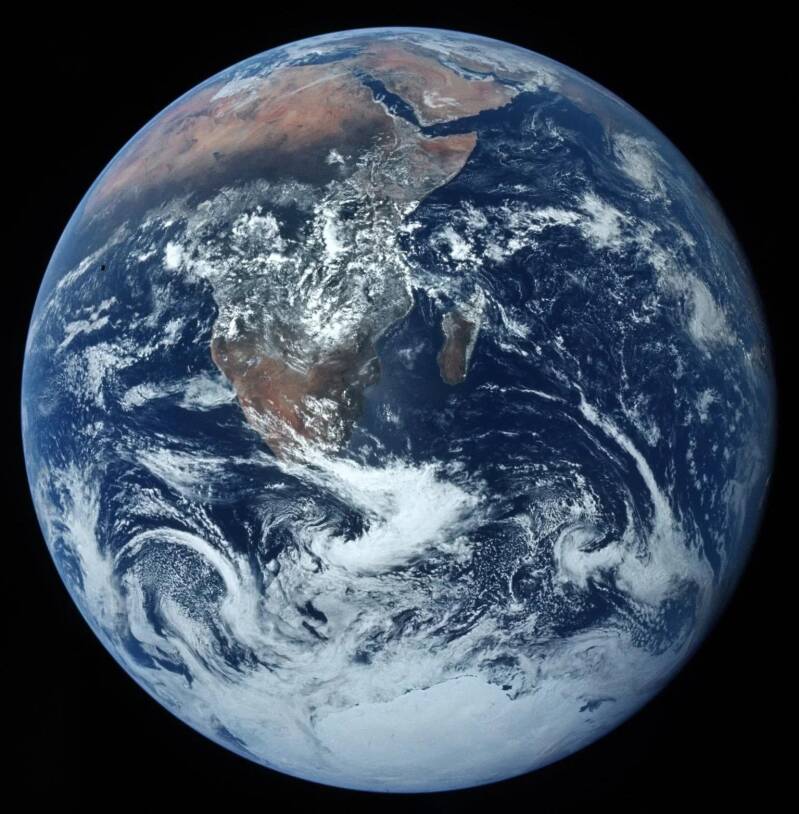
Earth exists in a relatively quiet region of the Milky Way, protected by a stable star, a magnetic field, and conditions that have allowed life to develop over billions of years.
By studying the most dangerous places in the universe, we gain a deeper understanding of not only the cosmos—but also why our small blue planet is such an extraordinary place to call home.

Want to Learn More?
Are you fascinated by space exploration, astronomy, and the greatest mysteries of our universe?
Follow our blog for more in-depth articles about NASA, historic space missions, scientific discoveries, and the facts behind the most discussed stories from space.
Stay informed about the latest developments as well as the fascinating mysteries that the universe still has waiting for us.
Francois Hoogstrate
Founder & Editor of DeepSpaceJournal
Francois Hoogstrate researches and writes about astronomy, NASA missions, cosmology, planetary science, and space exploration. His articles focus on presenting complex scientific topics in a clear, balanced, and accessible way, using information from official space agencies, scientific publications, and historical sources.
Sources & References
- NASA
- Black Holes
- https://science.nasa.gov/universe/black-holes/
- Gamma-Ray Bursts
- https://science.nasa.gov/universe/gamma-ray-bursts/
- ESA
- Gaia Mission
- https://www.esa.int/Science_Exploration/Space_Science/Gaia
- ESO
- Betelgeuse
- https://www.eso.org/public/
- (zoek op "Betelgeuse")
- Event Horizon Telescope
- https://eventhorizontelescope.org/
- Virgo Collaboration
- https://www.virgo-gw.eu/
- Chandra X-ray Observatory
- https://chandra.harvard.edu/
- James Webb Space Telescope
- https://science.nasa.gov/mission/webb/
- Scientific Papers
- Einstein (1915)
- The Field Equations of Gravitation
- https://einsteinpapers.press.princeton.edu/
- Schwarzschild (1916)
- https://ui.adsabs.harvard.edu/
- Hawking (1974)
- Black Hole Explosions?
- https://www.nature.com/articles/248030a0
- GW170817 (Neutron Star Merger)
- https://journals.aps.org/prl/abstract/10.1103/PhysRevLett.119.161101
- Event Horizon Telescope (2019)
- https://eventhorizontelescope.org/press-release-april-10-2019-astronomers-capture-first-image-black-hole
- Sagittarius A* (2022)
- https://eventhorizontelescope.org/press-release-first-image-black-hole-milky-way-galaxy
- Betelgeuse Distance (Gaia)
- https://www.aanda.org/
Add comment
Comments